

Few challenges are more frustrating in product development than discovering stability issues late in the development cycle. A formulation that appears robust during early screening can unexpectedly exhibit aggregation, sedimentation, viscosity changes, or inconsistent performance during scale-up, storage, sterilization, or end use.
Whether developing a nanoparticle therapeutic, a particle-containing drug product, a medical device coating, or an advanced materials dispersion, stability issues can emerge at any stage of development.
When these failures occur, attention often turns to particle size, processing conditions, or raw material variability. Yet in many cases, the underlying issue lies at the particle surface. Understanding how particles interact with their surrounding environment can provide critical insight into product behavior long before visible signs of instability appear.
At Cambridge Polymer Group (CPG), zeta potential analysis is frequently used to help clients evaluate colloidal stability, investigate formulation challenges, and identify potential risks early in development. By characterizing surface charge, researchers can gain a deeper understanding of the forces governing particle interactions and make more informed formulation decisions.
Instability Often Starts at the Surface
Particles in suspension are constantly subjected to competing forces. Attractive interactions encourage particles to come together, while repulsive forces help keep them dispersed.
When attractive forces dominate, particles may begin to aggregate, eventually leading to flocculation, sedimentation, or changes in product performance. For pharmaceutical, medical device, and advanced materials applications, these changes can impact product quality, manufacturability, and long-term stability.
Zeta potential provides a quantitative measure of surface charge and serves as an indicator of the electrostatic repulsion between particles. While it is not the sole determinant of stability, it can be an important early warning sign of a system’s susceptibility to aggregation.
As a general guideline, systems with zeta potential values greater than approximately ±30 mV tend to exhibit sufficient electrostatic repulsion to support stable dispersions, while values closer to zero are often associated with increased instability.
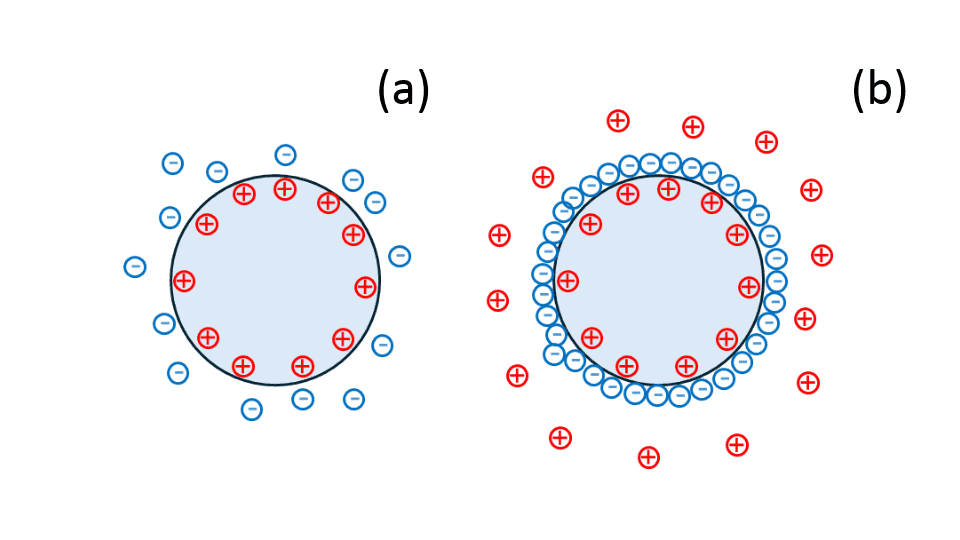
Figure 1. Schematic illustration of how surface chemistry influences colloidal stability. (a) A particle with limited electrostatic stabilization is more susceptible to attractive interactions. (b) Increased surface charge strengthens repulsive forces between particles, helping maintain a stable dispersion.
Why Formulation Conditions Matter
One of the most important aspects of zeta potential is that it is highly sensitive to the surrounding environment.
Factors such as pH, ionic strength, conductivity, buffer composition, and biological media can significantly influence surface charge. As these conditions change, particle interactions can change as well.
This has important implications throughout the product lifecycle. Formulations rarely remain in a single environment. They may experience changes during manufacturing, transportation, sterilization, storage, or clinical use. A system that performs well under one set of conditions may behave very differently under another.
As a result, understanding how particle behavior responds to realistic operating conditions can help development teams identify stability risks before they evolve into costly development setbacks.
Case Study: The Impact of pH on Surface Charge and Stability
A recent CPG study illustrates how changes in solution chemistry can significantly influence particle interactions and dispersion stability. Researchers evaluated a carbohydrate-based suspension at two pH conditions using electrophoretic mobility measurements and zeta potential analysis.
At pH 2.5, the measured zeta potential was approximately +1.6 mV, indicating a nearly neutral surface charge. At this level, electrostatic repulsion between particles is minimal, increasing the likelihood of aggregation and instability. When the pH was adjusted to 7.0, the zeta potential shifted to approximately −31.9 mV. This substantial increase in surface charge generated significantly greater electrostatic repulsion, resulting in a markedly more stable dispersion.
The findings illustrate a key lesson for product developers: stability is not simply a material property. It is often heavily influenced by the environment surrounding the material. In some cases, relatively minor adjustments to formulation conditions can significantly improve colloidal stability without changing the underlying particle composition.
| Sample pH | Temperature [°C] | Zeta Potential [mV] | Mobility [µmcm/Vs] | Conductivity [mS/cm] |
| 2.5 | 25 | 1.6 ± 0.1 | 0.122 ± 0.012 | 1.107 |
| 7.0 | 25 | -31.9 ± 0.7 | -2.501 ± 0.056 | 0.029 |
Figure 2. The measured electrophoretic mobility, the sample conductivity and the zeta potential of sample in pH 2.5 (red trace) and sample in pH 7.0
Common Stability Questions Zeta Potential Can Help Address
When instability begins to emerge, identifying the root cause quickly can save valuable development time and resources. Zeta potential analysis can help answer several common questions:
- Why is a suspension aggregating during storage?
- Why does product performance change after processing or sterilization?
- How will particles behave in physiological environments?
- Are surface-modification strategies producing the desired effect?
- Could changes in pH or ionic strength improve stability?
- Are batch-to-batch differences affecting particle interactions?
Addressing these questions early can help organizations reduce development risk and avoid expensive reformulation efforts later in the product lifecycle.
Applications Across Product Development
Because surface interactions influence so many products, zeta potential analysis has become a widely used characterization technique across multiple industries.
In pharmaceutical and biotechnology applications, it supports nanoparticle characterization, formulation development, protein stability studies, and suspension optimization.
In medical device development, zeta potential measurements can help evaluate surface-modified materials, coating performance, and interactions with biological environments where protein adsorption and fouling may affect functionality.
In advanced materials applications, the technique can be used to optimize dispersions used in coatings, inks, battery slurries, composites, and other particle-based systems where consistent performance depends on maintaining a stable suspension.
Turning Stability Data into Development Insight
Identifying stability risks requires more than a single measurement. Understanding how particles interact with their environment often demands a combination of analytical approaches that connect material properties to real-world performance.
At Cambridge Polymer Group, zeta potential measurements are frequently combined with particle sizing, microscopy, rheology, surface characterization, and stability studies to investigate formulation behavior from multiple perspectives. Together, these techniques can help development teams better understand the factors influencing colloidal stability, reduce uncertainty during development, and make more informed decisions throughout the product lifecycle.