
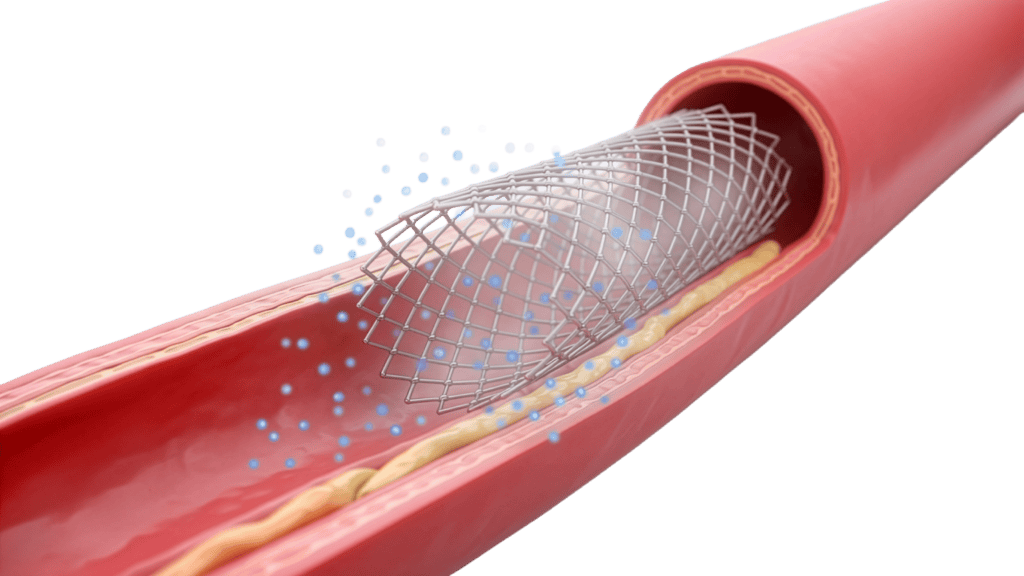
Drug-eluting stents (DES) have significantly improved outcomes for patients undergoing coronary interventions by reducing the risk of restenosis following implantation. The therapeutic effectiveness of these devices depends on controlled drug delivery, and long-term performance is influenced by the polymer coating responsible for delivering the active pharmaceutical ingredient (API).
For manufacturers, understanding how these coatings change over time is increasingly important. Beyond demonstrating coating durability and drug release performance, developers are under growing pressure from regulators to characterize polymer degradation, identify degradation products, and assess their potential impact on safety and device performance.
To help answer these questions, Cambridge Polymer Group (CPG) partnered with a cardiovascular device manufacturer to investigate the degradation behavior of a polymer-coated drug-eluting stent under physiologically relevant conditions.
Expanding the Scope of DES Characterization
Drug-eluting stents consist of a metallic stent framework coated with a polymer matrix containing an API. Following implantation, the polymer coating controls drug release kinetics over time. The sustained drug release helps to inhibit excessive cell proliferation and reduces the likelihood of restenosis.
Historically, DES characterization has focused on demonstrating coating durability and therapeutic performance through evaluation of:
- API release kinetics
- Stent expansion durability
- Resistance to cracking, peeling, and fatigue
While these assessments remain critical, industry focus has expanded beyond coating integrity and drug release to include the long-term behavior of polymer excipients. As polymers degrade, changes in molecular structure and coating composition can influence drug delivery, biocompatibility, and overall device performance. Consequently, understanding degradation pathways and degradation products has become an increasingly important aspect of product development, risk assessment, and regulatory evaluation.
This shift is driving demand for analytical techniques capable of characterizing not only API release but also the evolution of polymer coatings throughout the life of the device.
Designing Physiologically Relevant Aging Studies
To investigate polymer degradation and API release, coated stents were subjected to in vitro aging conditions designed to simulate physiological exposure.
The study evaluated variables including temperature, conditioning media composition, and aging duration. Careful selection of aging conditions is essential to generating meaningful data, as overly aggressive environments can produce degradation mechanisms that differ from those observed in vivo.
By designing studies that closely reflect physiological conditions, manufacturers can gain a more accurate understanding of long-term coating performance and better predict clinical behavior.
Applying Gel Permeation Chromatography to DES Analysis
Gel Permeation Chromatography (GPC) is widely used to characterize polymer molar mass distributions, previously referred to as molecular weight distributions (MWD), and assess changes in polymer structure during degradation.
For this project, CPG leveraged GPC not only to monitor shifts in molecular weight distribution, but also to quantify the amount of polymer coating and API remaining on the stent throughout the aging process. By combining refractive index and UV detection, the analysis provided a comprehensive view of both polymer degradation and drug release behavior.
Simultaneous assessment of multiple performance attributes using a single analytical platform generated a detailed picture of coating evolution over time.
Results: Characterizing Coating Changes During Aging
The analysis revealed several important trends related to polymer degradation, coating loss, and API release as aging progressed.
Changes in Polymer Molecular Weight
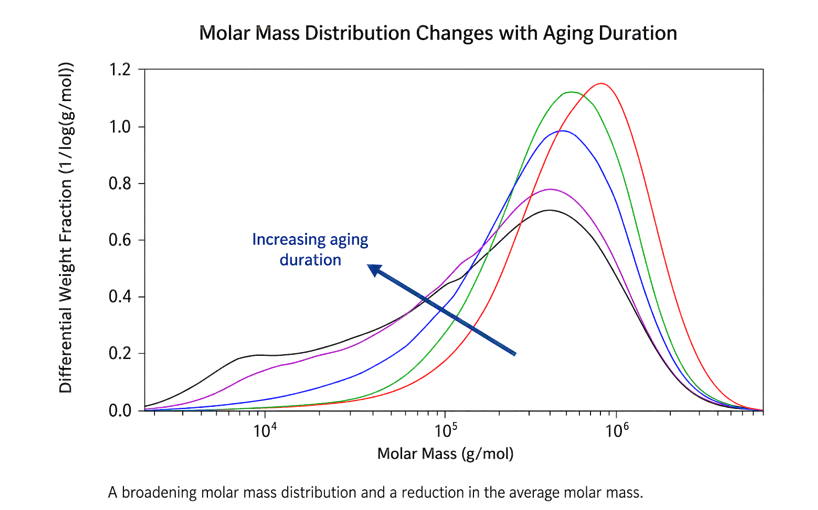
GPC analysis revealed a progressive broadening in the polymer molecular weight distribution with increasing aging duration. At the same time, the molecular weight decreased, indicating the formation of lower molecular weight species as degradation proceeded.
These findings are consistent with polymer chain scission and provide direct evidence that the coating’s molecular structure was changing throughout the study.
Loss of Polymer Coating Mass
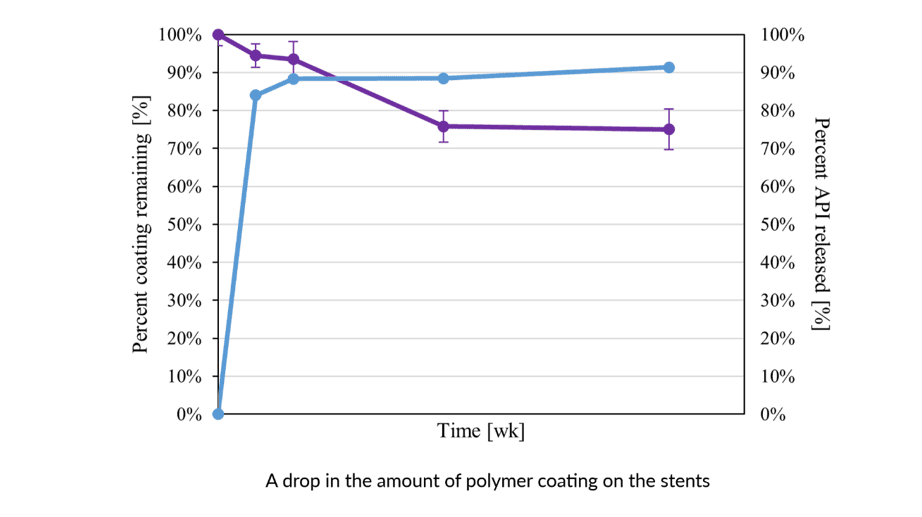
In addition to changes in polymer molar mass, the amount of polymer remaining on the stent decreased over time. This loss suggests that degradation products were released into the aging media as the coating degraded.
In addition to changes in polymer molar mass, the amount of polymer remaining on the stent decreased over time. This loss suggests that degradation products were released into the aging media as the coating degraded. Monitoring coating mass loss alongside molecular weight changes provided a more complete picture of the degradation process and helped guide ongoing efforts to identify degradation products and establish a complete mass balance for the system.
API Release Behavior
The API demonstrated a characteristic release profile consisting of an initial burst release followed by a transition to near zero-order release.
Understanding this relationship between polymer degradation and drug release is essential for optimizing coating formulations and ensuring consistent therapeutic performance throughout the intended treatment period.
Investigating Degradation Products
Preliminary analysis did not identify polymeric or oligomeric degradation products within the aging media. These findings suggest that degradation may predominantly yield smaller molecular species rather than larger polymer fragments.
Additional chromatographic analyses are ongoing to identify degradation products and establish a complete mass balance for the system. Such characterization is critical for understanding degradation mechanisms and supporting safety assessments.
From Polymer Characterization to Better Development Decisions
As expectations for medical device characterization continue to evolve, manufacturers increasingly need data that extends beyond conventional release testing and coating durability assessments. Understanding how polymer coatings change over time can provide critical insight into the relationship between material degradation, drug release, and long-term device performance.
Comprehensive polymer characterization can help answer critical questions, including:
- How does the coating chemistry change over time?
- What degradation pathways are present?
- How does degradation affect API release?
- What degradation products are generated?
- Are observed material changes consistent with the intended safety and performance profile?
By answering these questions early in development, manufacturers can make more informed decisions regarding material selection, coating design, testing strategies, and product risk assessments. These insights can also help establish a stronger scientific rationale for design choices and support a more proactive approach to device development.