
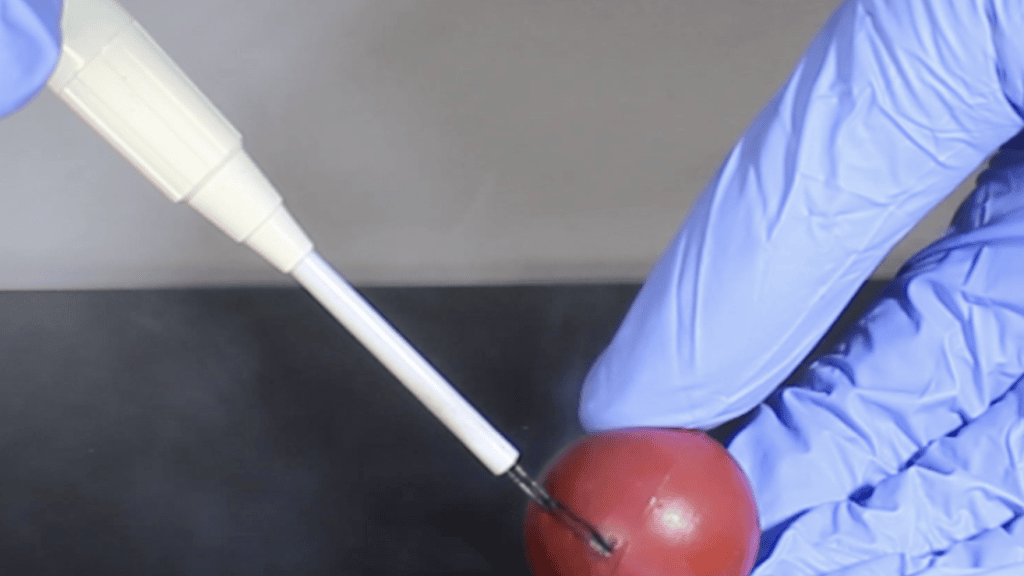
Synthetic Tissue Models for Electrosurgical Training
At Cambridge Polymer Group (CPG), we develop and characterize advanced polymer systems, including hydrogels and other soft solids, to deliver controlled, application-specific material performance. A growing focus area is synthetic tissue models, engineered materials designed to replicate the complex mechanical, thermal, and electrical behavior of real tissue while offering improved consistency, safety, and scalability compared to biologic alternatives.
Replicating tissue response for electrosurgical applications presents a unique challenge. As explored in our previous work on the mechanical and rheological complexity of tissue cutting, accurately simulating how tissue deforms, fractures, and responds under energy requires more than matching a single property, it requires a fully engineered material system.
Through collaboration with Pulse MDM, CPG’s material expertise and hydrogel development capabilities help enable platforms like E Tissue, a non-biologic solution commercialized by Pulse MDM for electrosurgical training and device evaluation.
The Challenge of Mimicking Tissue Under Electrosurgery
Mechanical and Thermal Complexity of Tissue Cutting
Real tissue behavior during cutting and electrosurgery is the result of several interacting factors:
• Mechanical deformation and fracture
• Electrical conductivity and current distribution
• Thermal response, including heating, charring, and vaporization
• Tactile and visual feedback experienced by the user
As discussed in our analysis of tissue cutting, performance depends on more than simple metrics like modulus. It involves fracture resistance, structural heterogeneity, and directional behavior that are difficult to replicate with conventional materials.
Limitations of Biologic Tissue Models
Traditional use of animal or cadaver tissue introduces challenges:
• Variability between samples
• Limited shelf life
• Complex logistics and storage requirements
• Biohazard and regulatory considerations
These limitations make it difficult to create consistent, repeatable electrosurgical training environments.
Non Biologic E Tissue for Electrocautery Training
Replicating Cutting, Char, and Energy Response
Engineered hydrogel systems can be designed to replicate multi-physics tissue behavior under energy-based tools.
Non-biologic E Tissue platforms enable:
• Controlled electrosurgical cutting behavior
• Realistic char formation and visual cues
• Responsive to monopolar and bipolar energy
• Repeatable performance across demonstrations and training sessions
Rather than relying on biologic variability, these systems use tunable material properties to match the requirements of specific procedures and devices.
These same characteristics can also support use in controlled device evaluation environments, where consistent and repeatable material behavior is essential.
Consistency and Repeatability in Training Models
Because material properties are engineered and controlled:
• Training outcomes are more standardized
• Device comparisons are more reliable
• Demonstrations are reproducible across locations and teams
Advantages of Synthetic Tissue Models Over Biologic Tissue
Operational Efficiency and Scalability
• No refrigeration or special handling requirements
• Easy to transport and deploy globally
• Rapid setup for training and demonstrations
Safety and Regulatory Benefits
• No exposure to biohazards
• No sterilization or special disposal requirements
• Suitable for operating room environments and trade shows
Customization for Device-Specific Training
• Materials can be tailored to anatomy, pathology, and procedure
• Enables device-specific simulation environments
Expanding Surgical Training with Engineered Tissue Models
Beyond electrocautery, CPG works alongside Pulse MDM to support the development of custom surgical training platforms built on application-specific soft material systems.
By combining:
• CPG’s expertise in hydrogel formulation and material characterization
• Pulse MDM’s expertise in model design and manufacturing
We deliver realistic, reproducible training environments aligned with specific procedures and devices.
Key Capabilities
Our engineered models are designed to capture:
• Procedure-specific tissue mechanics and handling
• Cutting, suturing, and device–tissue interactions
• Energy–tissue responses across modalities (RF, laser, etc.)
• Relevant anatomical structures and pathological conditions
Applications
• Device-specific training and product demonstrations
• Simulation of minimally invasive and open procedures
• Evaluation platforms for emerging surgical technologies
• Scalable training solutions for global clinical and commercial teams
This approach enables fit-for-purpose systems that align with device performance, clinical workflows, and training objectives.
Beyond Training: Engineered Hydrogels Across Industries
While synthetic tissue models are a valuable tool for surgical training and evaluation, they represent just one application of CPG’s broader capabilities in engineered soft materials.
At Cambridge Polymer Group, hydrogels are developed and evaluated to control material behavior under mechanical, thermal, and electrical inputs, enabling their use across a wide range of industries.
Applications include:
• Medical device R&D and performance benchmarking
• Robotics, haptics, and human–material interaction
• Energy-based system modeling (RF, laser, ultrasound)
• Dermal, cosmetic, and aesthetic technologies
• Materials science and applied research
• Industrial testing and product safety evaluation
Partnering for Custom Hydrogel Development
CPG supports clients across the product lifecycle by:
• Developing application-specific hydrogel formulations
• Performing mechanical, thermal, and electrical characterization
• Designing test methods and evaluation protocols
• Conducting performance validation and failure analysis
This combination of material design and testing expertise enables translation of complex material behavior into reliable, real-world performance.
Learn More About Non-Biologic Tissue Models and Hydrogel Solutions
Non-biologic tissue models are transforming how the industry approaches electrosurgical training, device evaluation, and material validation.
Explore:
• Platforms like E Tissue, commercialized by Pulse MDM
• CPG’s expertise in engineered hydrogels and material performance
Contact us to learn more about custom hydrogel development and synthetic tissue models