
Jaimee Robertson, Director of Consulting View PDF
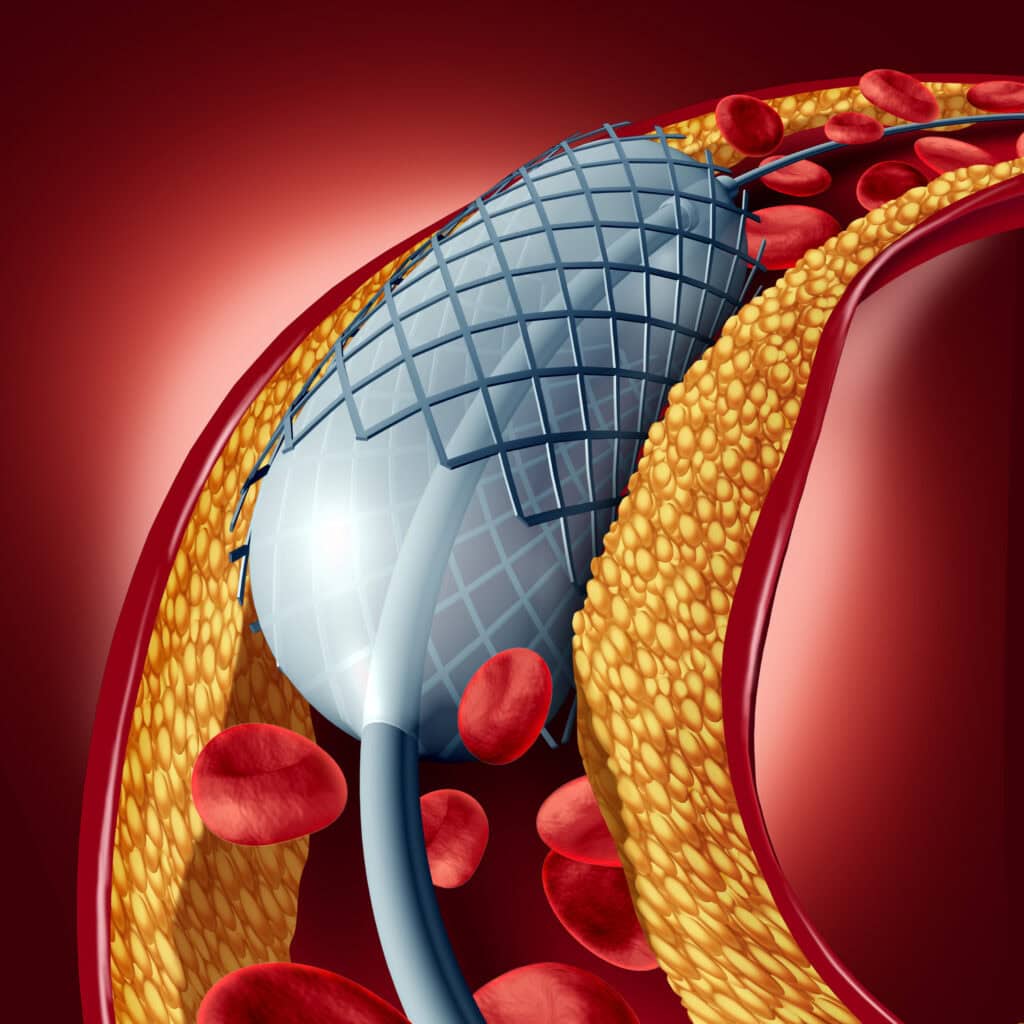
Drug-eluting stents are designed to reduce restenosis, or re-narrowing of arteries after stent implantation. Typically, a polymer containing an active pharmaceutical ingredient (API) is coated on metallic stent struts, and the API is released over time to block cell growth within the implanted stent.
Beyond biocompatibility and safety assessment, drug-eluting stent characterization has historically focused on API release kinetics and stent/coating durability. Manufacturers typically demonstrate coating integrity by confirming the absence of cracks/peeling after expansion and fatigue. More recently, there has been increased emphasis on characterizing the fate of polymer excipients.
Cambridge Polymer Group (CPG) partnered with a cardiovascular company to understand the degradation behavior of a polymer coating on a drug-eluting stent.
In Vitro Degradation and Release
Coated stents were subjected to conditions designed to simulate physiological degradation and API release. The conditions considered variables such as temperature and conditioning media composition. Careful selection of aging conditions is critical to ensuring physiological relevance.
Gel Permeation Chromatography (GPC)
GPC is commonly utilized to characterize polymer molar mass distributions (MWD). Here, GPC was employed not only to evaluate changes in the molar mass distribution of the polymer coating but also to quantitate the amount of polymer coating and API remaining on the stent by exploiting refractive index and UV detection.
Results
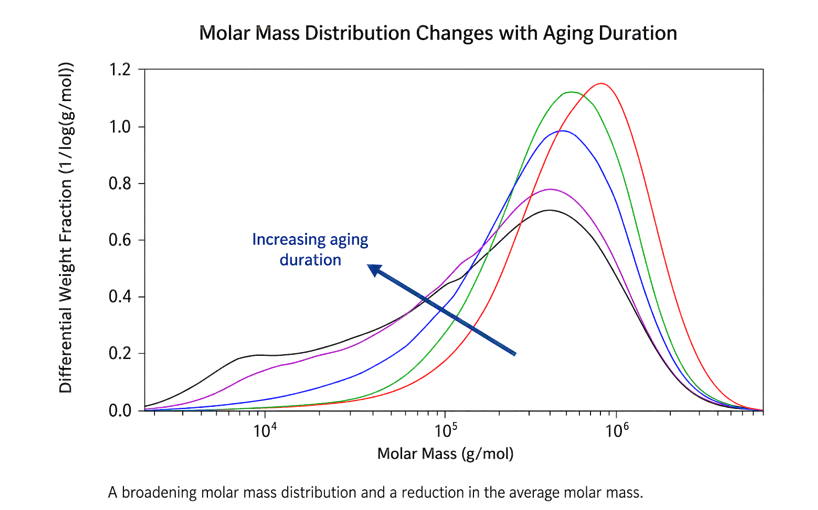
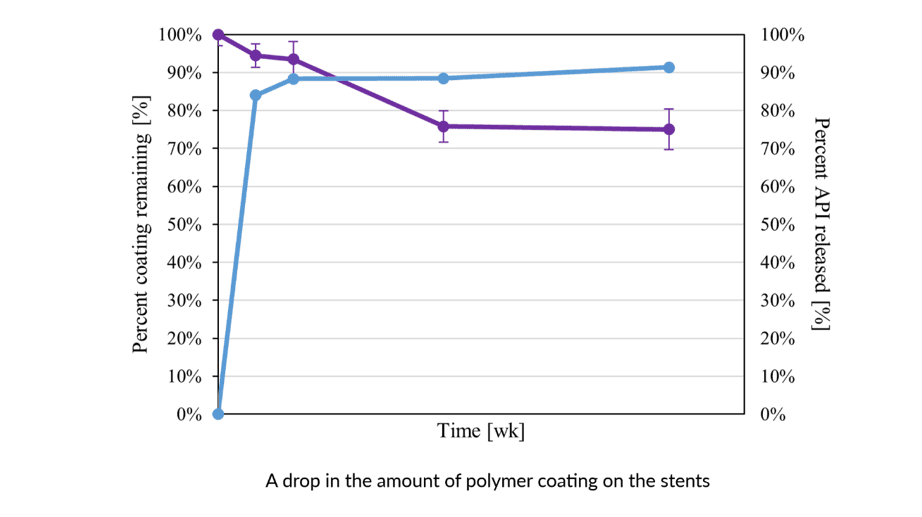
GPC analysis showed a steady decrease in molar mass and broadening of the polymer MWD with increasing aging duration. Simultaneously, there was a loss of polymer and API mass on the stent, i.e., degradants were lost to the aging media and API was released from the coating. The API exhibited an initial burst release that transitioned to zero-order release with time. Preliminary results did not identify polymeric or oligomeric degradation products in the aging media, suggesting that the degradants may be small molecule compounds. Ongoing efforts are focused on characterizing the aging media using chromatography to provide a mass balance and identification of degradation products.
Loss of Polymer Coating Mass
Key Points
- Understanding polymer degradation is critical to predicting long-term performance and safety of products over time.
- GPC is a powerful analytical tool for evaluating changes to polymer structure and concentration that occur under physiological conditions.