

Mimoza Xheka, Research Scientist View PDF
Summary
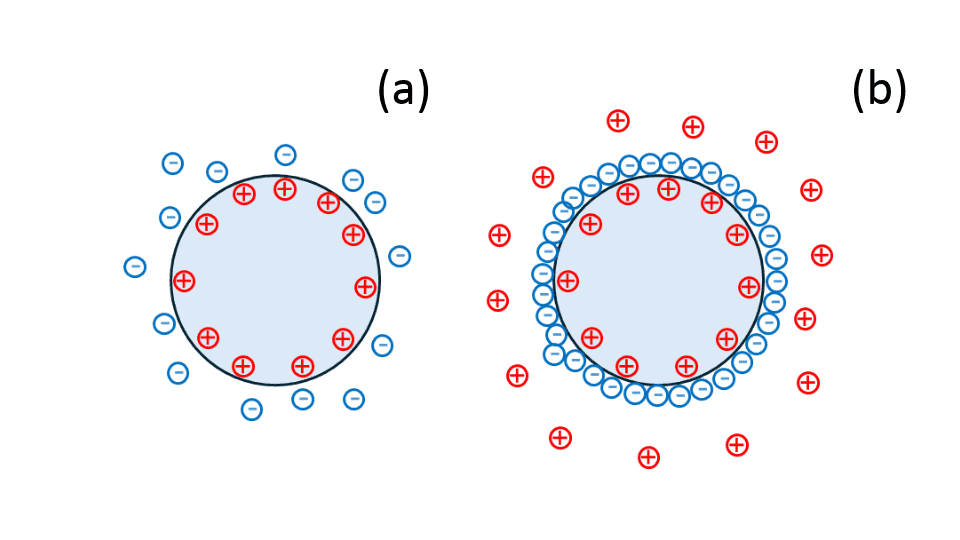
Figure 1: Schematic representation of the electrostatic stabilization mechanism whereby the overlap of the diffuse layers generates strong repulsive forces. (a) Positively charged particle with a diffuse layer, which mainly consists of anions. (b) Positively charged particle with adsorbed saturated layer of a highly charged anionic electrolyte, which makes the particle negatively charged and gives stability to the colloidal system.
The surface chemistry of particles in dispersion governs how they interact, whether they attract, repel, or remain stably suspended. These principles apply broadly across materials science, pharmaceuticals, biotechnology, and medical devices, wherever colloidal stability and surface interactions are critical.
A key parameter used to quantify these interactions is the zeta potential, defined as the electrical potential difference between the particle surface (including its tightly bound ionic layer) and the surrounding bulk fluid. The magnitude of the zeta potential provides a practical indication of the stability of a colloidal system.
Zeta potential measurements are widely used to optimize dispersions, emulsions, and suspensions, including pharmaceutical formulations (e.g., nanosuspensions, lipid-based systems, protein therapeutics), medical device coatings, and advanced material slurries. Systems with high positive or negative zeta potential typically exhibit strong electrostatic repulsion, preventing particle aggregation. In contrast, systems with low zeta potential are susceptible to aggregation due to attractive forces such as van der Waals interactions, hydrophobic effects, and hydrogen bonding.
In pharmaceutical and biological systems, low zeta potential can lead to aggregation, sedimentation, or reduced shelf life, while in medical device applications it may impact coating uniformity, dispersion stability, or interactions with biological fluids.
As a general guideline, dispersions with zeta potentials greater than approximately ±30 mV are considered stable (Table 1). However, zeta potential is highly dependent on pH and ionic strength (conductivity), and these parameters must always be reported alongside measured values.
| Zeta potential value (mV) | Stability behavior |
| 0 to ±5 | Flocculation or coagulation |
| ±10 to ±30 | Incipient instability |
| ±30 to ±40 | Moderate stability |
| ±40 to ±60 | Good stability |
| Greater than ±60 | Excellent stability |
Table 1: Stability behavior of the colloid based on zeta potential value.
Colloidal systems are least stable at the isoelectric point (IEP), where the zeta potential is zero. At this condition, electrostatic repulsion is minimized, increasing the likelihood of aggregation. In pharmaceutical and medical device systems, operation near the IEP is often avoided due to risks of rapid aggregation, protein adsorption, or surface fouling.
Introduction
Zeta potential cannot be measured directly. Instead, it is calculated from electrophoretic mobility, which describes the velocity of particles under an applied electric field. This relationship is defined by the Henry equation:
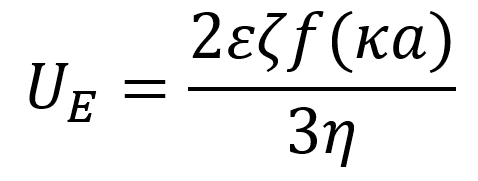 Where:
- Uₑ: Electrophoretic mobility
- ζ: Zeta potential
- ε: Dielectric constant
- η: Viscosity
- f(κα): Henry’s function
- κ: Debye length (inverse electrical double-layer thickness)
- α: Particle radius
The ratio κα reflects the relationship between particle size and the surrounding double-layer thickness, influencing how mobility is interpreted.
Measurements are commonly performed using instruments such as the Malvern Zetasizer Nano ZS90, which utilizes laser Doppler electrophoresis. In this technique, particles move under an applied electric field and scatter incident laser light. The motion induces a frequency (Doppler) shift in the scattered light, which is used to calculate electrophoretic mobility.
Modern systems employ Phase Analysis Light Scattering (PALS), where phase shifts rather than frequency shifts are measured. This approach improves sensitivity, particularly for samples with low mobility, and is widely used in both research and regulated environments for formulation characterization, comparability studies, and quality assessment.
In pharmaceutical and biotechnology applications, zeta potential supports formulation development and stability optimization, while in medical device development it is used to evaluate surface-modified particles, coatings, and interactions in physiological environments.
Experimental
Electrophoretic mobility measurements were performed on carbohydrate-based suspension samples at a concentration of 1 mg/mL in water. Samples were analyzed using a folded capillary cell with electrodes at each end.
Upon application of an electric field, charged particles migrated toward the electrode of opposite charge. Their velocity was measured and used to calculate electrophoretic mobility and zeta potential.
Measurements were conducted at two pH values (pH 2.5 and pH 7.0) to assess the effect of solution conditions on particle charge and stability. Conductivity was also recorded to account for ionic strength effects.
| Sample pH | Temperature [°C] | Zeta Potential [mV] | Mobility [µmcm/Vs] | Conductivity [mS/cm] |
| 2.5 | 25 | 1.6 ± 0.1 | 0.122 ± 0.012 | 1.107 |
| 7.0 | 25 | -31.9 ± 0.7 | -2.501 ± 0.056 | 0.029 |
Table 2: The measured electrophoretic mobility, the sample conductivity and the zeta potential of sample in pH 2.5 (red trace) and sample in pH 7.0
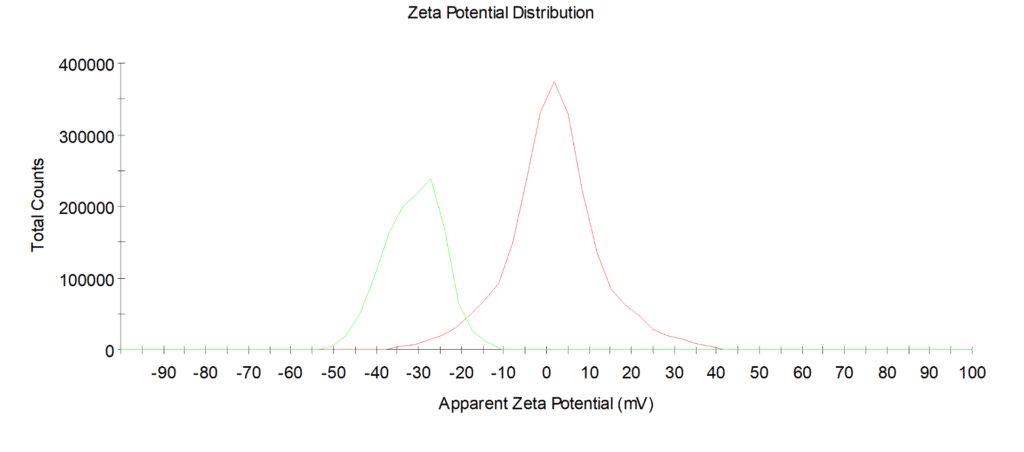
Figure 2: Zeta potential distribution for sample in pH 2.5 (red trace) and sample in pH 7.0 (green trace).
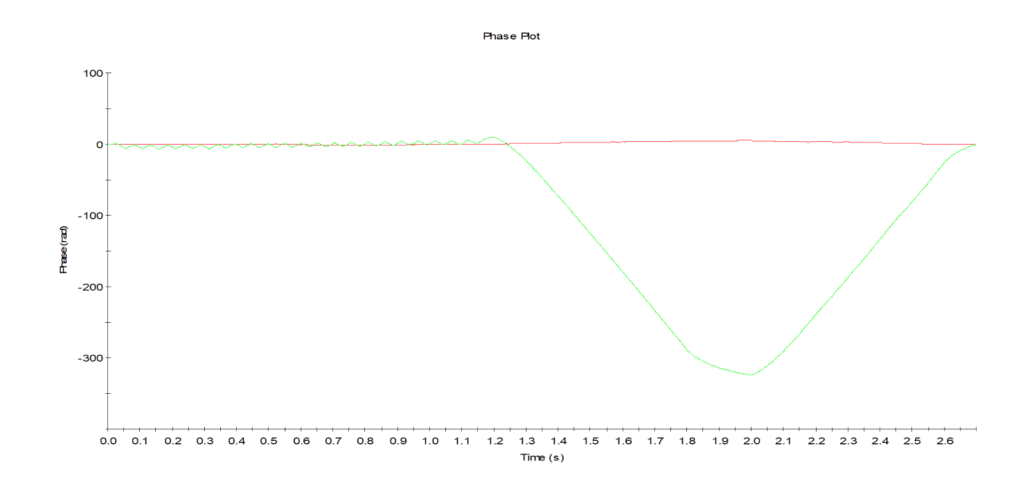
Figure 3: The phase plot shows the difference in phase between the measured beat frequency and the reference frequency as a function of time for sample in pH 2.5 (red trace) and sample in pH 7.0 (green trace). The reference frequency in the Zetasizer Nano is that of the optical modulator (320 Hz).
Results & Discussion
The results demonstrate a strong dependence of zeta potential on pH. At pH 2.5, the zeta potential is close to neutral (1.6 mV), indicating minimal electrostatic repulsion between particles. Under these conditions, attractive forces dominate, making the system prone to aggregation and instability.
At pH 7.0, the zeta potential shifts to -31.9 mV, indicating a highly charged system with sufficient electrostatic repulsion to maintain particle dispersion. According to Table 1, this corresponds to a moderately to well-stabilized system.
Zeta potential distributions (Figure 2) confirm this behavior, with a broader, near-neutral distribution at pH 2.5 and a sharper, more negatively shifted distribution at pH 7.0. Phase plots (Figure 3) further illustrate the increased electrophoretic response at neutral pH.
From an application perspective, these results highlight the importance of controlling solution conditions. Adjusting pH or ionic strength can significantly improve dispersion stability, extend shelf life, and enhance performance.
- In pharmaceutical systems, this strategy can reduce aggregation and improve product robustness.
- In medical device applications, it can optimize coating stability and control interactions with biological fluids such as saline or plasma.
- In materials and energy applications, it enables better dispersion of particles in slurries and manufacturing processes.
Conclusions
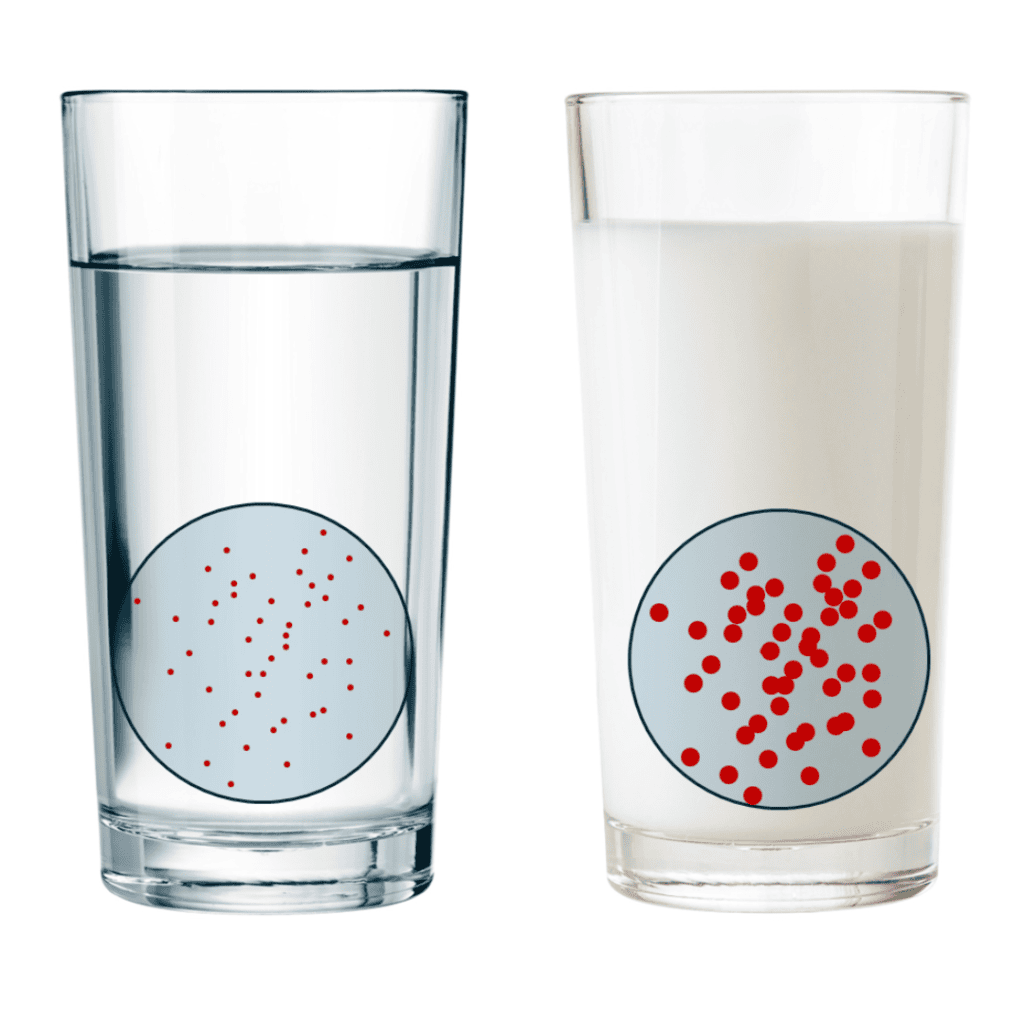
Comparison of a stable particle dispersion (left) and an aggregated dispersion (right). Higher zeta potential generally promotes particle repulsion and stability, while lower zeta potential can lead to aggregation and reduced dispersion stability.
Zeta potential is a powerful and versatile parameter for assessing the electrostatic properties of particles in colloidal systems. It provides critical insight into particle interactions, dispersion stability, and surface behavior.
As a rapid and cost-effective analytical tool, zeta potential measurement supports:
- Formulation development
- Stability prediction
- Process optimization
- Batch-to-batch consistency
In pharmaceutical and biotechnology applications, it is used to optimize formulations, reduce aggregation risk, and improve product stability. In medical device development, it helps evaluate surface-modified materials, coating performance, and interactions with biological environments, including protein adsorption and fouling.
Zeta potential measurements are widely applied across industries, including:
- Pharmaceuticals and biotechnology
- Medical devices
- Materials science and advanced manufacturing
- Cosmetics and personal care
- Food and beverage systems
- Energy storage (e.g., battery slurries)
- Environmental science and water treatment
- Coatings, inks, and dispersions
By understanding and controlling zeta potential, researchers and engineers can design more stable, effective, and reliable systems across a wide range of applications.
References
Shaw, R. Fundamentals of Dynamic Light Scattering; ATA Scientific.
https://www.chem.uci.edu/~dmitryf/manuals/Fundamentals/DLS%20concept.pdf
Zeta Potential. ScienceDirect Topics; Elsevier.
https://www.sciencedirect.com/topics/pharmacology-toxicology-and-pharmaceutical-science/zeta-potential