
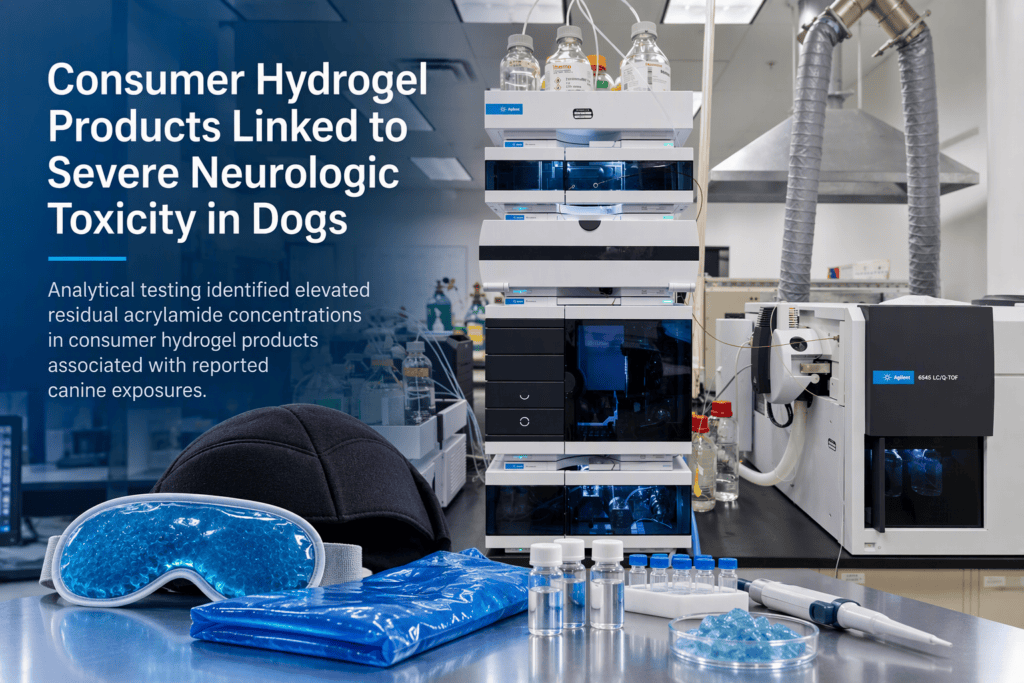
Many polymer-based hydrogel products are designed to improve comfort and quality of life. From cooling pads to migraine relief caps, these products rely on water-containing polymer networks that can retain moisture and provide extended cooling performance.
Unfortunately, recent veterinary toxicology investigations suggest that some hydrogel products may contain unexpectedly high concentrations of a known neurotoxic contaminant: acrylamide monomer.
As a co-author on a recently published Journal of the American Veterinary Medical Association (JAVMA) study, I gained insight into 45 cases of suspected acrylamide toxicosis in dogs following ingestion of consumer hydrogel migraine caps, eye masks, and wraps that were investigated by the study team. The findings expand on earlier reports linking hydrogel ingestion to neurologic illness while also raising broader questions about material characterization, manufacturing controls, and residual chemistry.
When Clinical Cases Reveal a Pattern
The investigation analyzed cases reported to the ASPCA Animal Poison Control Center between January 2024 and June 2026. Researchers identified dogs that had ingested hydrogel-containing migraine caps, eye masks, or wraps and showed clinical signs consistent with exposure. Among the 45 cases included in the analysis, neurologic abnormalities were prominent and often severe.
Reported signs included:
- Seizures
- Ataxia (loss of coordination)
- Tremors
- Anxiety and agitation
- Restlessness and frantic behavior
- Aggression
- Hyperesthesia (heightened sensitivity)
- Hyperthermia
- Lethargy and depression
Vomiting and tachycardia were also commonly reported. In at least one case, behavior suggestive of hallucinations was described. Laboratory findings frequently included hypokalemia, hyperglycemia, and hemoconcentration.
Perhaps most concerning was the severity of outcomes. Of the 21 dogs for which outcomes were known, 14 either died or were euthanized, underscoring the potentially life-threatening nature of these exposures.
From Clinical Observations to Chemical Analysis
The clinical presentation prompted investigators to look more closely at the hydrogel itself.
Many cooling and therapeutic hydrogel products are based on polyacrylamide, a polymer used in a wide range of commercial, industrial, and medical applications. Polyacrylamide itself is generally considered to have low toxicity. Acrylamide monomer, the precursor used to produce polyacrylamide, is a recognized neurotoxin.
Residual acrylamide is expected to be present only at very low levels in properly manufactured polyacrylamide materials. Determining whether elevated concentrations might be present in the hydrogel products became a critical question.
What the Testing Revealed
We analyzed hydrogel samples obtained from the implicated products and measured acrylamide monomer concentrations ranging from 12,900 to 51,800 parts per million (ppm). These concentrations are higher than the upper end of reported levels across industries and orders of magnitude higher than residual acrylamide limits specified for a polyacrylamide hydrogel used in medical devices (2.5iPAAG).
Consumer hydrogel products may fall into a regulatory gap that limits adverse event tracking, highlighting the importance of establishing residual acrylamide monomer limits to prevent potentially harmful exposures. The study also raises important questions about product claims.
Several of the products involved in these cases were marketed using terms such as “medical grade” and “nontoxic.” These claims may have had a profound influence on owner perception of risk, potentially creating an expectation of safety that was inconsistent with the chemical composition of the products. The findings demonstrate that broad material classifications and marketing terminology should not be viewed as substitutes for chemical characterization and toxicological evaluation.
The analytical findings aligned closely with clinical observations. While analytical testing alone cannot definitively prove causation, the combination of:
- Consistent neurologic signs,
- Strong evidence of product exposure, and
- Elevated acrylamide concentrations
supports the conclusion that acute acrylamide toxicosis was the most plausible explanation for these cases.
Building on Earlier Findings
This study builds upon earlier investigations into canine neurotoxicity associated with hydrogel ingestion.
In a previous CPG blog article, we discussed a cluster of cases involving ingestion of hydrogel from a commercial cooling pet pad. Analytical testing identified acrylamide monomer at approximately 4,900 ppm, supporting a hypothesis that acrylamide exposure may have contributed to the neurologic signs observed in affected dogs.
The newly published JAVMA study broadens the scope considerably. Rather than a single product line, the investigation examined multiple consumer hydrogel products and identified acrylamide concentrations that were often several times higher than those found in the cooling-pad investigation. The larger dataset and more severe clinical outcomes provide additional evidence that elevated residual acrylamide can represent a significant safety concern in certain hydrogel-based products.
Lessons for Product Developers and Manufacturers
For manufacturers of polymer-based products, these findings illustrate an important principle: the safety profile of a finished material is influenced not only by the intended polymer but also by residual constituents, impurities, and process-related contaminants.
Material characterization and analytical testing play a critical role in identifying potential risks before products reach the marketplace. Testing strategies that evaluate residual monomers and other extractable compounds help manufacturers better understand their materials, monitor manufacturing consistency, and assess potential biological risks.
Unexpected adverse events often require collaboration across multiple disciplines, including toxicology, veterinary medicine, analytical chemistry, and materials science. In this case, clinical observations led to targeted analytical testing that helped identify a plausible chemical explanation for a serious toxicologic concern.
The Value of Analytical Investigation
When product safety questions arise, the answer is rarely found through clinical observations alone. Analytical chemistry provides a bridge between reported outcomes and material composition, helping investigators move from suspicion to evidence.
The recent JAVMA publication demonstrates how combining toxicology, epidemiology, and analytical testing can help uncover risks that may not be evident from material descriptions alone. The products involved in this study shared a common polymer, yet the residual chemistry associated with those products had not been investigated.
As hydrogel technologies continue to expand across consumer and medical applications, understanding the complete chemical profile of a material remains essential. A polymer name provides useful information, but it does not fully define the safety profile of a material. Potential risk may arise not only from residual monomers, but also from additives, processing aids, impurities, degradation products, and other known or unknown chemical constituents present within the final product.
Reference: Wegenast C, Haugen A, Waratuke K, Bader R, Spiegelberg S, Wilt B, Kane M. Suspected acrylamide toxicosis associated with ingestion of consumer polyacrylamide-based hydrogel migraine caps, eye masks, and wraps in 45 dogs. Journal of the American Veterinary Medical Association. Published online October 2, 2026.