
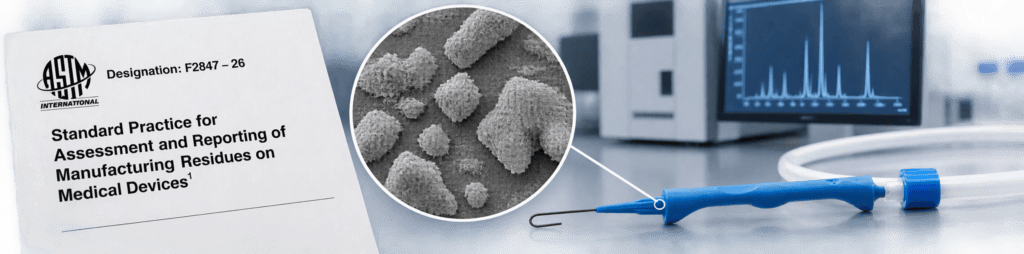
ASTM has published ASTM F2847-26, the latest revision of its guide covering analytical techniques used to identify and quantify manufacturing residues on medical devices.
Originally developed by an ASTM task group established in 2003 by personnel from Cambridge Polymer Group (CPG) and other ASTM volunteers, the guide was created to help users select analytical techniques appropriate for the residues being investigated. Since its initial publication, it has been used by manufacturers and testing laboratories assessing device cleanliness and manufacturing residues.
Expanded Scope and Applicability
One of the most significant changes in ASTM F2847-26 is clarification and expansion of the types of devices and contaminants to which the standard applies.
According to members of the task group, users were applying the guidance to a broader range of products and contamination scenarios than originally envisioned. The revised standard reflects that experience by broadening its applicability and clarifying where the guide may be used.
For users of previous versions, this change may reduce the need to identify deviations when applying the standard outside implantable-device applications.
New References for Analytical Techniques
The revised document also incorporates new references that may be useful when applying specific analytical techniques.
Added in response to user feedback, these references reflect practical experience with the standard and provide additional guidance for selecting analytical methods.
Establishing Residue Limits
ASTM F2847-26 also expands discussion of how residue limits may be established for medical devices, an area that continues to generate questions among manufacturers and regulators.
The standard provides several rationales that may be used when establishing residue limits for a specific device. Rather than prescribing a single approach, the guidance recognizes that residue limits must be considered in the context of the device, its materials, and its intended use.
ASTM is also developing a separate standard that is expected to provide further clarification in this area.
CPG’s Continued Involvement
CPG personnel participated in both the original development of ASTM F2847 and the latest revision. F2847-26 represents a significant update to the standard and reflects the evolution of industry practices since its original publication.
If you are evaluating manufacturing residues, developing a cleanliness assessment strategy, or selecting analytical methods for residue characterization, CPG can assist with applying ASTM F2847-26 and designing an appropriate testing approach.