
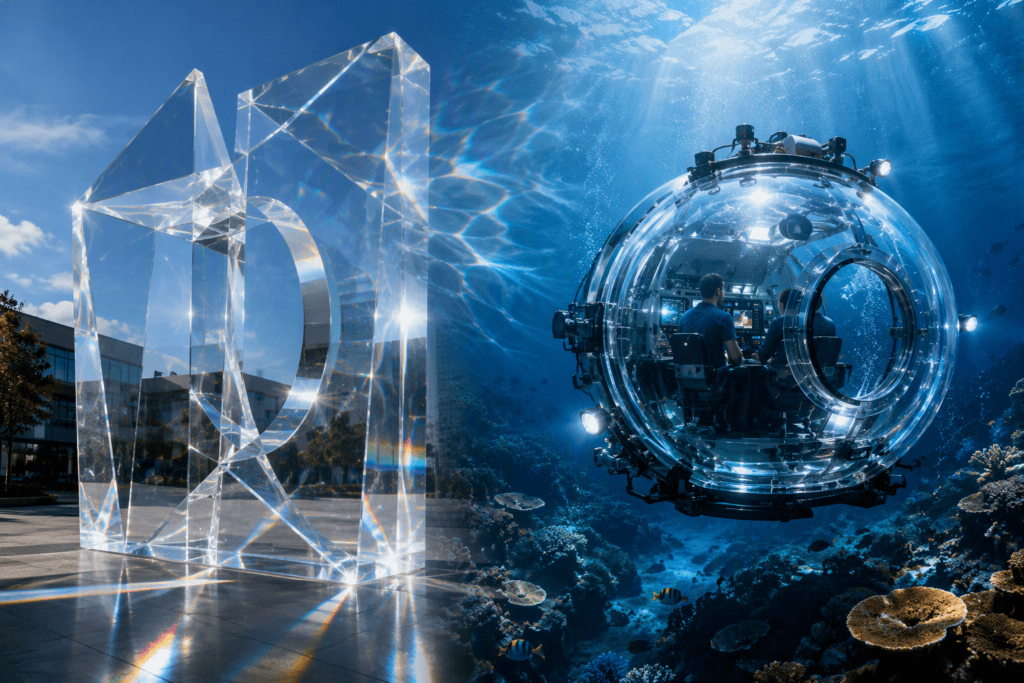
When An Artist Advances Polymer Technology
Innovations in plastic technology do not always originate in research laboratories. Sometimes they come from unexpected places.
One of the most consequential advances in large-scale acrylic casting began with artist Bruce Beasley’s desire to create monumental sculptures that manipulated light. Acrylics are transparent polymers derived from acrylic acid and related chemistries, widely used in windows, displays, lenses, and countless other applications. However, before the 1970s, manufacturing large cast acrylic structures presented a significant challenge.
As acrylic castings increased in size and thickness, trapped air bubbles became increasingly difficult to eliminate. These bubbles reduced both optical clarity and mechanical integrity, limiting the size of structures that could be produced successfully.
In the late 1960s, Beasley became fascinated by acrylic as an artistic medium. He envisioned large transparent sculptures that could transform natural light and create dramatic visual effects in public spaces. When discussing his ideas with engineers at DuPont, he learned that producing bubble-free castings at the scale he envisioned would be extremely difficult. Rather than abandoning the concept, Beasley approached the challenge as a process development problem.
In 1970, Beasley entered a competition to create a sculpture for the California State Capitol. His design, Apolymon, would ultimately stand approximately 15 feet tall, weigh 13,000 pounds, and be cast entirely from acrylic. Because optical clarity was central to the sculpture’s effect, bubbles were unacceptable.
To overcome the problem, Beasley developed a new casting approach using a vacuum autoclave process that enabled the production of large, bubble-free acrylic components. The technique proved successful, and Apolymon was installed at the California State Capitol from 1968-1970, demonstrating that acrylic structures could be cast on a scale previously considered impractical. Images of Beasley’s creative acrylic structures can be found at his website.
But Can You Make a Bathysphere?
Beasley’s success attracted attention beyond the art world. At the time, oceanographic engineers were exploring ways to improve deep-sea observation vehicles. Traditional bathyspheres and submersibles were typically constructed from steel, with only small viewports available for observation. While effective structurally, these designs severely limited visibility. The ability to cast large, optically clear acrylic structures suggested a new possibility: a transparent pressure sphere.
Working with oceanographic engineers, Beasley applied his acrylic casting expertise to produce two large transparent acrylic hemispheres. The hemispheres were then bonded together to create a complete spherical pressure vessel. Images of Beasley’s casting process to make the sphere can be found on his website.
The result was a transparent acrylic sphere used in the Johnson-Sea-Link submersible, providing dramatically improved visibility compared with conventional designs. The submersible was capable of operating at depths of approximately 3,000 feet and was used in hundreds of dives, including missions associated with the search for Space Shuttle Challenger debris following the 1986 disaster.
Innovation through Process Development
The story of Bruce Beasley’s acrylic work is ultimately not about art or deep-sea exploration. It is about solving a materials problem through process innovation. The acrylic itself was not fundamentally new. The breakthrough came from understanding how processing conditions influenced the final material properties and then systematically refining those conditions to achieve a desired outcome.
That same principle applies throughout polymer development today. Whether the goal is improved mechanical performance, enhanced optical properties, increased durability, or better manufacturing efficiency, success often depends on identifying the right combination of material selection, formulation, and processing conditions.
At Cambridge Polymer Group, this type of challenge is frequently addressed using Design of Experiments (DOE) methodologies. By systematically evaluating variables and their interactions, DOE helps accelerate process optimization, reduce development risk, and achieve targeted material performance more efficiently.
Beasley’s work serves as a reminder that polymers often possess capabilities beyond their apparent limits. In many cases, the key to unlocking those capabilities is not a new material, but a new approach to processing it.