
Why Gravy, Cranberry Sauce, and Pumpkin Pie Behave So Differently
Thanksgiving dinner presents a challenge that makes many materials scientists smile. While rheology is often associated with polymers, pharmaceuticals, coatings, adhesives, and medical devices, some surprisingly good examples can be found at the Thanksgiving table.
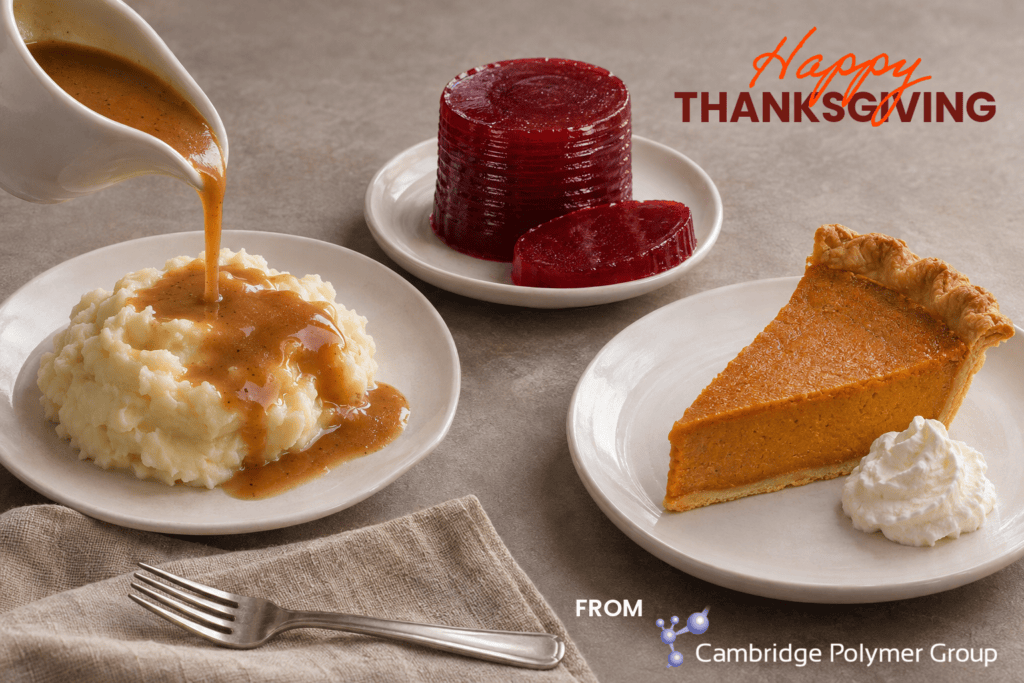
The gravy is too thin and it floods the plate. Too thick and it refuses to leave the gravy boat. The cranberry sauce somehow holds its shape despite being mostly water. And pumpkin pie remains perfectly sliceable until the moment your fork breaks through the filling.
None of these behaviors are accidents. They are examples of the complex interplay of ingredients and processing. These properties are best described analytically by rheology, the study of how materials respond to stress, deformation, and flow.
The Gravy Test
Anyone who has made gravy knows there is a very narrow window between success and disappointment. At rest, good gravy should appear rich and substantial. Once poured, however, it should flow smoothly across mashed potatoes rather than landing in a single immovable lump.
This behavior is a form of shear thinning, in which a material’s apparent viscosity decreases as the rate of deformation increases. The gelatinized starches in the gravy create a microstructure that causes higher viscosity at low shear rates. As the gravy is stirred, poured, or spread, that structure is disrupted and aligned, allowing it to flow more easily. The presence of proteins in the gravy further enhance this behavior. As an aside, another critical aspect of gravy’s behavior is its temperature dependence. Keep it warm and it flows and coats your dinner plate. Allow it to cool (or chill it) and the gravy gels and becomes a solid.
The same principle appears in products ranging from paints and coatings to pharmaceutical formulations. A material may need to remain stable during storage while still being easy to process, dispense, or apply. Or it may be required to coat a surface without dripping or draining, while be readily applied. In other words, a successful gravy formulation is not entirely different from many industrial and medical formulation challenges.
Why Cranberry Sauce Wobbles
Few Thanksgiving foods are as recognizable as canned cranberry sauce sliding onto a plate and retaining the exact shape of the container it came from. Despite its ubiquity, this is actually a fairly impressive materials science demonstration.
Cranberries naturally contain pectin, a polysaccharide that forms a network capable of trapping water. The result is a hydrogel with characteristics of both a liquid and a solid. Rheologists describe this type of behavior as gelation and is best characterized by the material’s viscoelasticity.
Push on cranberry sauce and it deforms. Remove the stress and it will recover. In the case of the tinned sauce, push harder and it breaks, but for homemade sauces it is more likely to flow. The sauce behave like solids in some situations, but like a liquid in others.
Many advanced materials rely on similar gel-network principles. Hydrogels used in drug delivery, wound care, and tissue engineering applications are also formed from polymer networks that trap large amounts of water while maintaining structural integrity. That familiar wobble on the holiday table turns out to be a useful lesson in polymer physics.
Pumpkin Pie’s Secret
Pumpkin pie may be the most structurally impressive item on the Thanksgiving menu. A good slice remains upright after serving. The filling does not run across the plate, collapse under its own weight, or separate into layers. Yet it yields easily when touched with a fork.
Materials scientists might understand this behavior using the concept of yield stress. Below a certain level of force, the filling behaves like a solid. Once sufficient stress (force) is applied, it begins to deform and flow. This balance is created by a complex network of starches, proteins, fats, and water that develops during baking. In fact, the whipped cream you might want to have with the pie is also an example of this. Push harder and it flows, but it “solidifies” when you stop pushing.
Many familiar products are designed around similar principles. Toothpaste should stay on a toothbrush until brushing begins. A sealant should remain in place after application. A cosmetic cream should dispense easily while maintaining stability in the container, or an ointment stays where it is applied, rather than draining away.
Pumpkin pie may not have been developed in a formulation lab, but it solves a remarkably similar engineering problem.
Science at the Dinner Table
Thanksgiving is not usually thought of as a lesson in materials science. Still, every plate offers examples of complex molecular structures, competing forces, and carefully balanced material properties.
The next time the cranberry sauce holds its shape, the gravy pours just right, or a slice of pumpkin pie stays perfectly intact, take a moment to appreciate the science behind the meal. The same rheological principles that determine whether gravy pours smoothly or cranberry sauce holds its shape are used to evaluate products ranging from medical device coatings and pharmaceutical formulations to consumer products and industrial materials.
Happy Thanksgiving from Cambridge Polymer Group. While most of us won’t be bringing a rheometer to the dinner table, the holiday is a good reminder that interesting material behavior is everywhere. Fortunately, if your gravy formulation fails, the consequences are usually much less severe than they are in a product development program.
Cambridge Polymer Group will be closed on Thursday, November 26, and Friday, November 27, in observance of the Thanksgiving holiday, and will resume normal business hours on Monday, November 30. If a polymer, materials, analytical, or product development challenge comes to mind over the long weekend, feel free to send us an email. We may be away from the lab and office, but we will be happy to review your questions and get back to you when we return on Monday.
We wish you a wonderful Thanksgiving and a relaxing holiday weekend.