
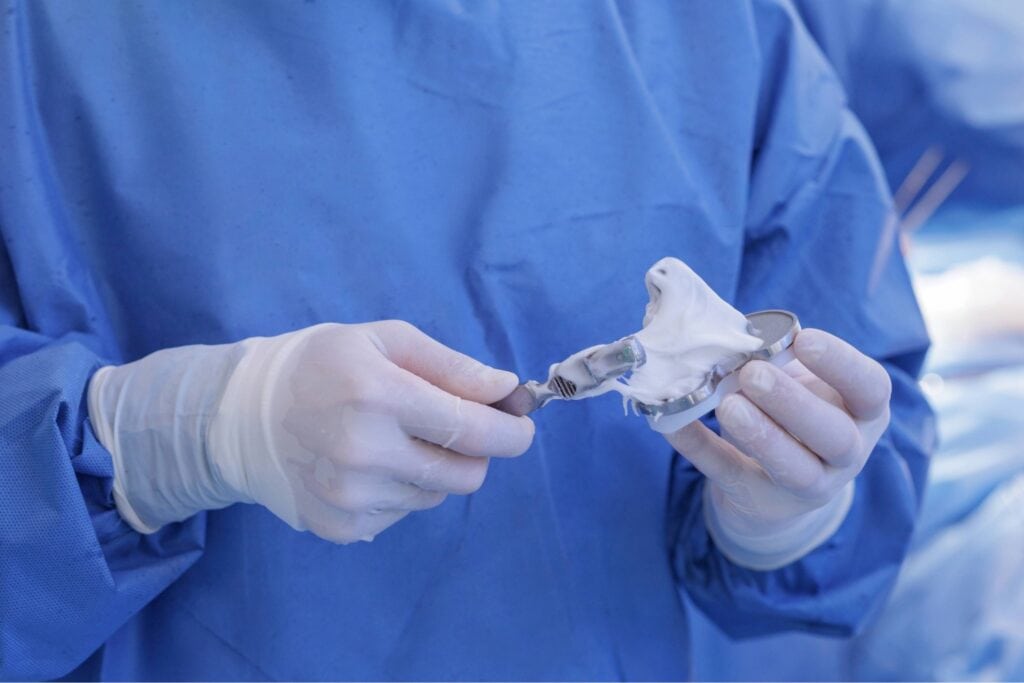
A production interruption at a major manufacturer has triggered a global bone cement shortage, forcing hospitals, especially in the UK, to delay or cancel hip and knee replacement surgeries, and prompting supply-chain reviews in other regions including the United States.
Why Bone Cement Matters in Orthopedic Surgery
Although many modern hip, knee, and shoulder replacements use cementless fixation, bone cement remains essential for a large number of procedures each week worldwide. Bone cement is typically based on polymethyl methacrylate (PMMA) and related copolymers and is applied as a paste or putty that undergoes a finishing polymerization reaction in the operating room to secure orthopaedic implants to surrounding bone.
This material is critical in:
- Primary cemented hip and knee replacements
- Trauma cases such as fractured neck of femur requiring cemented stems
- Complex revision surgeries and infection management where antibiotic-loaded cement is needed[1]
What Caused the Current Bone Cement Shortage?
One of the major suppliers of bone cement, Heraeus Medical, had to halt production of bone cement at one of its main production sites in February, leading to a global shortage of bone cement. [2] Heraeus informed its customers on February 16, 2026, that a critical machine failure occurred at their main production site, and anticipates a supply shortage of pouch cements for at least 2 months. [3] NHS notices describe this as a packaging fault affecting certain bone cement pouches and raising concerns about their potential sterility, so newly manufactured stock cannot be released for use until the issue is resolved.[4] This shortage has resulted in the cancellation of thousands of hip and knee surgeries in the United Kingdom, which receives the majority of its cement from Heraeus. Competing bone cement manufacturers are stepping in to help provide bone cement stock to hospitals. [5]
Impact on Patients and Hospitals
In the United Kingdom, health authorities and professional societies report that hospitals are delaying or cancelling joint replacement procedures as they prioritize trauma, oncology, and high-risk revision cases that cannot safely be postponed. Elective procedures that can be performed with cementless implants are being rescheduled where appropriate to conserve available cement.
Because Heraeus is a major international supplier, this event has been described as a global bone cement supply issue, with ripple effects beyond the UK. In the United States, the impact appears more limited so far, in part because hospitals typically source bone cement from a broader mix of manufacturers.
However, US institutions that use Heraeus products may still see:
- Tightened availability or longer lead times for specific brands or SKUs
- Pressure to substitute with alternative PMMA bone cements or antibiotic-loaded formulations
- Increased scrutiny from value analysis, pharmacy, and supply chain teams when changing cement products
Expert commentary on the UK situation emphasizes the importance of diversifying bone cement sources and rapidly, but carefully, validating alternative products, recommendations that are equally relevant for US hospitals and device manufacturers.
How Cambridge Polymer Group Can Help
For medical device manufacturers, responding effectively to this shortage requires more than simply listing compatible cements. It demands evidence-based understanding of how different bone cements behave with specific implant designs, and how process or formulation changes may influence performance, handling, and risk profiles.
Cambridge Polymer Group scientists are experts at bone cement characterization and comparison. We co-chair the ASTM task group on bone cement and regularly provide testing services on bone cement and related orthopedic materials. We can assist manufacturers with:
- Comparative testing of bone cements
Evaluating alternative PMMA bone cements against currently specified products, including mechanical properties (e.g., strength, fatigue behavior), working and setting times, and thermal profiles. - Chemical and thermal characterization
Assessing formulation differences, polymerization behavior, residual monomer content, and porosity to understand how these factors may influence long-term performance and biocompatibility. - Evaluation of antibiotic-loaded cements
Measuring antibiotic elution profiles, stability, and interactions with mixing and curing conditions, supporting claims related to infection management strategies. - Manufacturing and quality investigations
In addition to testing finished bone cement products, Cambridge Polymer Group can help manufacturers investigate and troubleshoot quality issues arising from their manufacturing processes. Using chemical, thermal, and mechanical analysis methods, our scientists can identify problems related to raw materials, mixing ratios, residual monomer, porosity, and polymerization behavior that may affect cement performance or consistency. We design custom studies to trace defects back to specific process steps, helping clients refine formulations, adjust process parameters, and support corrective and preventive actions. - Regulatory and risk‑management support
Generating data sets and technical reports that feed into risk assessments, design dossiers, design changes, and communications with regulators and notified bodies when cement specifications or suppliers change.
By combining bone cement expertise with a deep understanding of polymer science and medical device requirements, Cambridge Polymer Group can help implant manufacturers respond proactively to this shortage, support their customers, and de‑risk transitions to alternative bone cement products.
If your organization is qualifying new bone cements, assessing the impact of supply changes on your devices, or investigating manufacturing-related quality issues, contact Cambridge Polymer Group to discuss a tailored testing and analysis strategy.
[1] https://www.england.nhs.uk/long-read/heraeus-medical-bone-cement-products/
[2] https://www.bbc.com/news/articles/cy8gexml5xro
[3] https://azuksappnpdsa01.blob.core.windows.net/datashare/3261-Heraeus-Medical-Customer-Letter-17-February-2026.pdf
[4] https://www.supplychain.nhs.uk/icn/supply-issues-heraeus-medical-bone-cement-products/
[5] https://www.england.nhs.uk/long-read/heraeus-medical-bone-cement-products/