Posted by Cambridge Polymer Group on | Comments Off on Get Rich to Avoid Infections
The Antimicrobial Properties of Silver
The phrase ‘blue bloods’ is associated with nobility or wealthy upper class. The etymology of the phrase has a few sources. One is that the pale skin associated with a non-laboring class of citizens allowed the blue veins to be better observed. A second, and more scientifically intriguing, source is that the silver cutlery, place settings, and goblets used by the wealthy and nobility imparted the users with a rich influx of silver ions, resulting in a healthy blue-ish patina on their skin.
Microbe Slayers in Medical Devices
Silver ions also impart some antimicrobial properties. Multiple researchers and companies have incorporated silver into wound dressings, salves, and medical devices to provide antimicrobial benefits. A potential issue of silver is that for efficacy against microbial agents, silver dose levels can often result in a toxic response in tissue. Fortunately for the ‘blue bloods,’ toxicity from ingested silver is fairly low, usually consisting of the cosmetic symptom of blue-grey skin.
Skinny Silver For a Better Bandage
Research from the University of Wisconsin-Madison has led to the development of a wound dressing comprised of a porous polymer nanofilm that contains elemental silver nanoparticles. The nanofilm is less than one cell thick, and is very conformable to the wound surface, allowing intimate contact with the wound. This intimate contact allows better material localization to the skin cells rather than the wound fluid, allowing lower silver concentrations, which may address the issue of silver ion toxicity in the skin cells.
While in past centuries the upper class may have been the sole beneficiary of silver’s antimicrobial properties, the University of Wisconsin-Madison researchers envision a day when silver nanoparticle band-aids are sold in drugstores.
Posted by Cambridge Polymer Group on | Comments Off on Antisocial Polymers
Social scientists have opined that social behavior is influenced both by environment and genetic makeup, the latter relating to our body chemistry. Interestingly, many polymers’ resistance to cracking follows these same two influences. Whereas some cracking results from excessive loads, or from thermal or UV degradation, a large percentage of plastic part failure results from a phenomenon termed environmental stress cracking (ESC), which is the result of an external chemical acting on a plastic part that contains internal stresses. The stress at which ESC cracking occurs is often well below the nominal fracture stress of the material.
Environmental Stress Cracking Examples
We often see examples of ESC in components that are subjected to regular exposure to cleaning agents. Hospital equipment, which will often see alcohols, surfactants, and disinfectants during reprocessing, often experience ESC after multiple cleaning cycles. Whereas ESC may not lead to parts failure or loss of functionality, they do result in a marred appearance, and may also lead to disinfection issues due to the generation of internal surfaces that may harbor microorganisms.
Polycarbonate is another thermoplastic that is susceptible to environmental stress cracking. Windows made from polycarbonate often show evidence of crazing (fine, silvery cracks) over time, which is the result of ESC (look at an airplane window next time you fly; you will likely see some crazing). Similar to the description above, crazing does not necessarily mean that the window’s integrity is compromised. Rather, the crazes have relieved localized stresses and may have stopped growing.
ESC Process
ESC occurs when a polymer component is exposed to a chemical when under stress. The stress may be residual stress resulting from a molding or machining process, or can be an externally applied stress during its application use. The chemical, almost always a liquid, does not result in bulk solvation or chemical degradation of the polymer. Rather, typical ESC chemicals are weak solvents for the polymer in question, and result in partial chain disentanglement in the regions of high stress. This chain disentanglement leads to localized plastic flow at stresses below the normal yield or fracture stresses, resulting in craze formation followed by cracking. The kinetics of ESC depend on the rates of the ESC chemical absorption and the relative rates of craze and crack formation, which are also influenced by the mechanical stresses in the samples.
ESC Morphology
ESC is characterized by brittle fracture surfaces, even occurring in polymers that normally exhibit ductile behavior. The crack morphology usually shows a smooth fracture plane, indicating a slow growing crack, as opposed to a striated surface indicating fatigue behavior. Since ESC often results in craze formation ahead of the crack, residual craze fibrils are sometimes evident on the fracture surface. ESC cracks often initiate from the surface, which is the source of the chemical cracking agent.
Nature VS. Nurture
So what materials (nature) and what environmental conditions (nurture) lead to situations where ESC is more likely? On the nature side, lower molecular weight polymers are more susceptible, since chain disentanglement is more likely. Additionally, polymers that have a lower amount of crystallinity, or that are amorphous, are more likely to exhibit ESC behavior, since crystalline domains have less free volume available for an ESC chemical to occupy. For this reason, polystyrene and polymethyl methacrylate (amorphous) are more susceptible to ESC than polyethylene (semicrystalline).
On the environmental side, the chemical makeup of the polymer is the primary determinant of which chemicals may act as ESC agents for a given polymer. Potential ESC agents include chlorinated hydrocarbons, aromatics, carbonyls, fatty acid esters, alcohols and aliphatic hydrocarbons, to name a few. Additionally, lower molecular weight ESC agents are more active than higher molecular weight due to improved ability to diffuse into the polymer structure.
Also on the environmental side, the nature of the loading is important. Tensile stresses are required to induce ESC; compression will not cause ESC, unless they lead to a component of tensile orientation in another plane. Additionally, residual stresses resulting from material orientation during injection molding can result in ESC.
ESC Testing
There are multiple approaches to testing materials and components for their propensity to exhibit ESC. ASTM F484 “Standard Test Method for Stress Crazing of Acrylic Plastics in Contact with Liquid or Semi-Liquid Compounds” describes a method where plaques of acrylic materials are flexed to specific levels of strain, and hence stress, while exposed to potential ESC agents for periods of time, while examining the plaques for evidence of craze or crack formation. Strain (stress) can be applied to samples in many ways, including a circular strain jig (detailed in ASTM D543 “Evaluating the Resistance of Plastics to Chemical Reagents”) or an elliptical Bergen jig, which applies a range of strains to a single sample bar. Chemical exposures can also be performed in several ways including immersion, wet patch, wipe, or spray.
Posted by Cambridge Polymer Group on | Comments Off on PET for Pets
Some of Cambridge Polymer Group’s staff spent last Friday’s lunch hour working with polymers for a good cause. Unlike our usual analytical testing and contract R&D, this particular work did not require a lab. We braided polyethylene terephthalate (PET) into dog toys for PetsEmpower, a non-profit that fosters and reunites pets with survivors of domestic violence. The polar fleece toys will be given to animals during and after their foster experience.
PET – A Warm and Fuzzy Material
From dog toys to astronaut underwear, polar fleece has infiltrated every aspect of our textile lives. It’s hard to believe this ubiquitous fabric was invented as recently as 1979. Two factors contributed to polar fleece’s widespread adoption. Firstly, extruded and then woven PET is a good replacement for wool; it is soft and warm, but not as scratchy as wool and certainly not as smelly when wet. Secondly, Malden Mills, the fabric’s inventor and manufacturer, chose not to patent the new technology, allowing other vendors to make the wool alternative. Although originally seen as an outdoor material, garment makers quickly recognized polar fleece’s potential benefits in applications beyond backpacking gear.
Polyethylene terephthalate is made by heating terephthalic acid with ethylene glycol (a.k.a. antifreeze). As the PET cools, it forms a viscous liquid. That liquid is then extruded through a nozzle, dried, and cut into plastic flakes. To make polar fleece, those flakes are heated and extruded through fine holes. As the liquid sprays out of the holes, it hardens into a fiber that is wound onto heated spools. In addition to making polar fleece out of virgin PET, it is also possible to use chopped up soda bottles.
PET Toys for PetsEmpower
The polar fleece toy is soft on the dog’s mouth, yet strong enough to withstand some pulling. Since the fabric is machine washable, it doesn’t matter how dirty it gets. These toys provide enrichment and chewing stimulation during and after the dog’s foster stay.
Why is the foster stay necessary? Some domestic violence survivors are reluctant to leave abusive living situations because of what will happen to their pets; most human shelters do not allow animal family members. PetsEmpower finds foster families for those animals so that domestic violence survivors can access resources without worrying about the safety and comfort of their pets. Once survivors have reestablished themselves in new environments, they are reunited with their pets.
Cambridge Polymer Group is proud to support PetsEmpower. We are grateful to Polartec (previously known as Malden Mills) for providing the navy polar fleece for the dog toys and to Building Impact for supplying the other colors and for facilitating this warm and fuzzy volunteer opportunity.
Posted by Cambridge Polymer Group on | Comments Off on Cooling Polymer Sheets
Warming from the sun occurs through the absorption of visible light and infrared light into materials whose molecular groups become energized at specific wavelengths, and the material warms. These molecules then can lose the energy by emitting it at different wavelengths, often in the infrared spectrum, cooling the material.
Passive Cooling
Creating surfaces that do not heat up as much has been a goal of material scientists interested in passive cooling systems, which are more cost and energy effective than active cooling systems like air conditioning and thermoelectric coolers.
Researchers have tried to make materials that do not absorb much infrared light, but are capable of absorbing heat from adjacent surfaces and then emitting the absorbed energy in the form of infrared radiation. Films of materials like this could be put on solar panels to drop their temperature to a level where they operate more efficiently, or could be used on the outside walls of buildings to reduce the internal temperature by a few degrees.
Cool as a Glass-Polymer Hybrid
Researchers at the University of Colorado-Boulder recently developed a composite structure made from a thin sheet of transparent plastic (polymethylpentene) which was infused with 8 micron glass beads. The sheet was coated on the back with silver. When put on another surface to be cooled, the silver reflected most of the visible light that contacted the sheet. The film also removed the heat from the underlying layer and reflected it in the mid-IR range. The glass beads act as IR resonators to make them efficient IR emitters. The Colorado researchers estimate that the films can reduce the surface temperatures by 10°C and can be made cost-efficiently.
Posted by Cambridge Polymer Group on | Comments Off on Breathe Easy
Biosafety Level 4 labs are used to study the deadliest pathogens known to humankind. In these labs, the scientists are garbed in protective suits that provide an external air supply and positive pressure throughout, to prevent inhalation and permeation of any airborne pathogens that may be present in the lab. The NY Times reported that the Center for Disease Control and Prevention recently discovered that the air hoses, composed of nylon, had never been properly tested to ensure that they were not releasing chemicals into the air stream that could potentially affect the scientist wearing the hazmat suit.
Lack of Cleaning Validation
To date, no one has gotten sick from the untested air hoses; the CDC discovered this validation omission as a result of a procedures and safety equipment audit. The current hoses were not designed for air transmission in humans, but were instead meant for carrying compressed air for power tools. Hoses designed for breathing equipment are tested for volatile components by the hose manufacturer or equipment assembly manufacturer.
Headspace GC-MS for Volatile Residues
Volatile residues from polymeric materials are often tested by head space gas chromatography with mass spectroscopy. CPG often performs this test to provide a risk assessment of potential elutable compounds from devices, particularly those devices that will be in contact with living tissue.
Posted by Cambridge Polymer Group on | Comments Off on Was the Mad Hatter Actually a Dentist?
Material Selection in Dental Fillings
So you indulged in a little too much holiday candy, and now need a cavity filled? There are several material choices, including amalgam alloy and composite resin.
Metal Amalgam vs. Polymeric Composite
If you had a filling prior to 1986, it was likely composed of an amalgam alloy, which is an alloy of mercury, silver, tin, and copper. The composition is carefully regulated by ISO 1559, to account for corrosion and dimensional changes. First used in the 1500s, amalgam remains a very successful material to this day, although concerns about its appearance and perceived issues with mercury toxicity have diminished enthusiasm for its use. Polymeric composite materials based on methacrylate chemistries have found greater use in restorative dental procedures, as these resins can be color matched to the native tooth.
Put On the Gloves
Earlier in the days of dentistry, some dentists would mix the amalgam in the palms of their hands, without gloves. Multiple studies have shown that dentists had higher levels of mercury in their bodies than the regular population. Mercury poisoning affects the central nervous system and the kidneys, resulting in tremors in the face and eyelids, and then affecting the limbs and handwriting. The regular use of gloves in dentistry is believed to have reduced issues with mercury accumulation in dentists, along with the increased use of non-mercury alloys and dental composites.
The Mad Hatter, by the way, is a reference to chronic mercury poisoning found in Victorian-aged hatmakers, which was used in the manufacturing of felt hats. Hatmakers of that era often had tremors, paranoia, shyness, and irritability.
Posted by Cambridge Polymer Group on | Comments Off on What Are Candy Hearts Made Of?
Sweetheart Conversation Hearts are an iconic symbol of Valentine’s Day. First created by the New England Confectionery Company in 1902, Sweethearts are Necco Wafers cut in heart shapes and stamped with romantic messages. The recipe hasn’t changed much since the early 20th century, but the messages are updated as popular vernacular evolves, and now include “Text Me” and “Tweet Me.” Although Necco makes more than 8 billion hearts a year, some candy aficionados aren’t impressed.
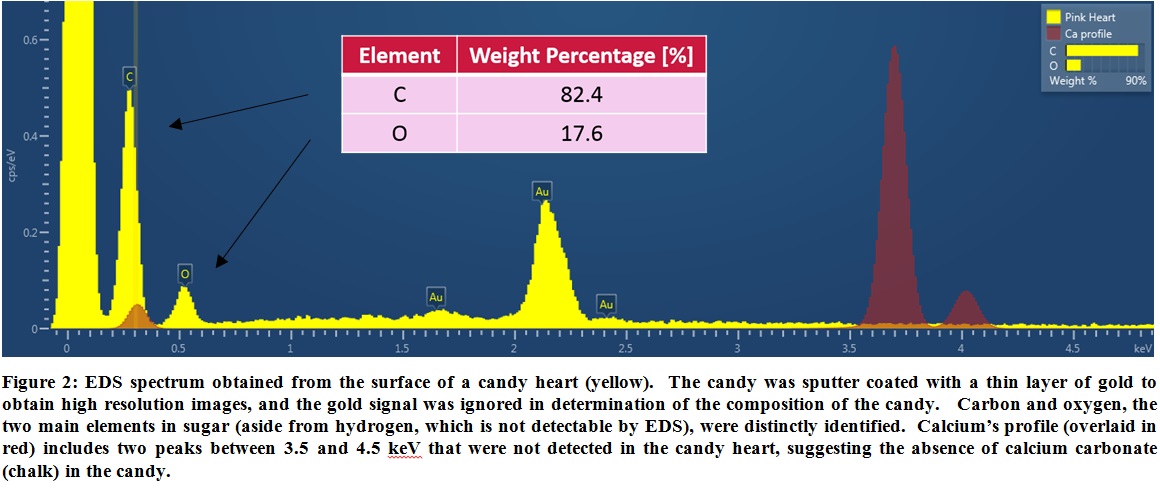
Complaints about Sweetheart’s chalk-like texture abound throughout popular culture and the blogosphere. CPG scientists decided to characterize candy hearts to see if they deserve their chalky reputation. We examined the chemical composition, surface topography, flavor and odor of candy hearts, using SEM, EDS, and HS-GC-MS.
Not surprisingly, EDS analysis (see Figure 2) showed the candy consisted of carbon and oxygen, the two main elements in sugar (aside from hydrogen, which is not detectable by EDS). The spectrum showed a complete lack of calcium signal, indicating the absence of calcium carbonate (chalk) in the candy.
Posted by Cambridge Polymer Group on | Comments Off on Just A Pinch of Salt Makes the Wheels Go Round
As the Boston area cleans up after another Nor’easter (New England’s name for a blizzard), we considered the practice of salting roads during and after these winter storms. If you have observed this practice, you will first notice that the salt used on roads bears little resemblance to the salt on your dining room table. The latter is mostly sodium chloride (NaCl), with the occasional trace amounts of other salts that provide pink hues or subtle flavors, a trend more popular in recent times (region-specific salts). Road salt, on the other hand, is a mix of sodium chloride, calcium chloride, as well as other chloride-based salts (potassium, magnesium). Since sodium chloride is fairly corrosive to roads, cars, and plant life, calcium chloride is used in combination more often. Road salt is usually blue or yellow in color. The actual salts used in road salt are all white. Manufacturers likely add a chemical indicator to provide a color tint, so that road work crews can see where they have salted.
The salts in road salt are highly soluble in water. When salt is placed in contact with ice, the local contact of the salt depresses the freezing temperature of the ice, which is normally 0°C (32°F). By freezing at a lower temperature, this means that the ice has to be held at a lower temperature to remain solid. For sodium chloride, this reduced temperature is -21°C (-6°F) under controlled conditions. Practically, sodium chloride will only melt ice when the roads are around -10°C or higher. The application of salt is the same as locally heating the ice above its melting point.
What is happening on a molecular level is that the ions from the salt (say Na+ or Cl-) want to associate with the water molecules in the ice. In the thin layer of water that sits on top of the ice, salt ions are sitting in solution at a fairly high concentration. Since nature does not like a concentration gradient, it sends more H2O molecules from the crystal structure into the liquid layer to try to dilute the salt concentration. Aside from the solubility of the salt in water, the amount of melting only depends on the concentration of salt, not its chemical nature, which is why this process is called a colligative property (e.g. it only depends on the concentration of species, not their chemistry). Elevation of boiling point is another colligative property. So as long as the salt concentration remains sufficiently high, it will continue to melt the ice underneath, and make the drive through New England towns a bit safer.
Posted by Cambridge Polymer Group on | Comments Off on From Catheters to Ski Boots: Polyether Block Amide Resins
Highly engineered thermoplastic elastomers are finding broad application use these days. Traditionally, elastomers often involved silicones, polyurethanes, or crosslinked rubbers. For applications requiring greater mechanical properties, such as impact strength, modulus, and fatigue strength, block copolymers comprised of polyether amide (PEBA) are often found.
PEBAs are formed from the condensation polymerization of a carboxylic polyamide with a polyether (often a polyethylene glycol terminated by alcohols). Varying the relative lengths and amounts of the blocks results in a range of mechanical properties, including elasticity and energy damping.
PEBA in Sports Equipment
PEBAs are often used in sports equipment. Its fatigue resistance and relative immunity to temperature-related property change makes it a good candidate for the shells of ski boots, and the energy damping behavior and low density makes PEBAs attractive for the damping system in running shoes.
PEBA in Medical Devices
PEBAs can be injection molded and extruded, which permits forming into narrow wall constructs. This behavior, coupled with its biocompatibility and the lack of a need for plasticizers, has resulted in PEBAs use in catheters, tubing, and cannula.
Contact CPG for assistance in selecting polymer materials for your specific application.
Posted by Cambridge Polymer Group on | Comments Off on A Tale of Two Footballs
Material Characterization of Synthetic vs. Leather Balls
The argument of synthetic over natural leather in football and other sports, such as rugby or basketball, ultimately comes down to ball feel and grip. Rugby has transitioned to synthetic surfaces (and anyone who ever caught a high ball made from leather in wet conditions is grateful for that), but in football the preferred elite ball composition is leather. Is that choice advantageous or is it purely a preference for the traditional? CPG scientists sought to determine how different the two types of footballs really are.
Leather vs. Pleather: Chemical Composition & Surface Topography
Fourier Transform Infrared Spectroscopy (FTIR) analysis confirmed that the leather football is comprised of animal hide, while the synthetic football is polyurethane-based. Not surprisingly, the FTIR spectra for the leather and synthetic material are markedly different.
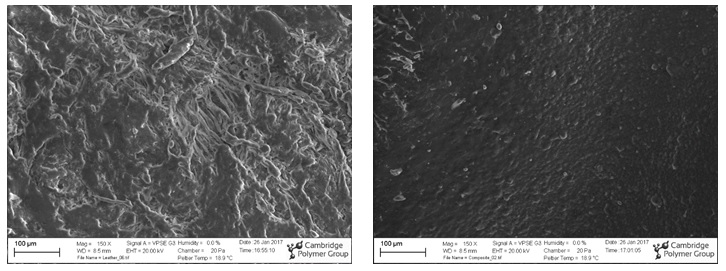
Scanning Electron Microscopy (SEM) showed differences in the surfaces of the two footballs. Natural animal hide is embossed to add the raised features into the leather football for improved friction. The added topography increases the surface area of the football, making it easier to catch. Synthetic materials were designed to mimic the same embossed texture, yet the details of the microscopic fibrous nature of the leather are not captured in the man-made football (see below).
SEM micrographs of the surface of a leather (left) and synthetic (right) football. At higher magnification, the leather football appears fibrous while the synthetic surface is covered with small bumps on the order of 10 µm in diameter.
Ranking Football Friction Properties
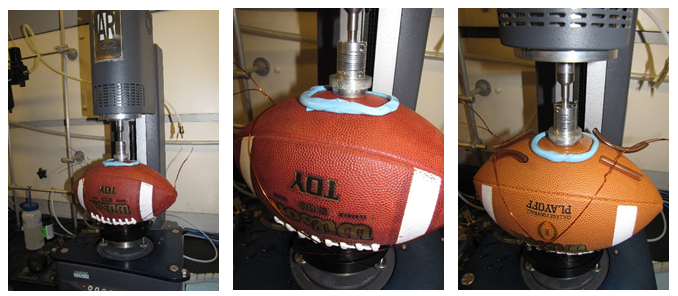
CPG scientists determined the friction on a synthetic and natural leather ball using a conventional method to yield a coefficient of friction (CoF) that allows ranking of relative frictional properties, and also how those frictional properties vary with speed and wet versus dry.
Images of ball testing configuration (left) on AR-G2 rheometer, and leather (middle) and synthetic (right) balls. Blue material is silly putty used as a barrier to enable water to be trapped in the contact region.
Dry
Under dry conditions, the synthetic material appears to have higher friction than the leather at all speeds. In both cases, the friction force increases with compression load, suggesting the grip gets better the harder the ball is held.
Wetted
The picture changes somewhat when the balls are wetted with distilled water. The synthetic ball actually exhibits a marked drop in frictional force at higher loads (the leather ball also sees a slight decrease). The leather ball would therefore have fairly consistent levels of grip, irrespective of how hard the ball were held, but the synthetic ball would have less grip at higher loads. Although minor, this observation already indicates that the leather ball may have an advantage in less-optimal playing conditions.
Soaked
When the balls are soaked in water, the difference is even more dramatic. The synthetic ball is impacted by the soak, but to the detriment of grip, with a gradual decrease in frictional force. In contrast, the frictional force on the leather ball goes up as the ball gets wet, suggesting in fact that this ball should have improved grip in wet conditions.
The weakness in this friction discussion is the choice of counterface. Most players either use bare hands (in the case of the quarterback) or silicone coated gloves (in the case of receivers). The steel counterface used here was a pragmatic choice, and may not truly represent the frictional force, which can be very sensitive to both the surface chemistry, and the conformability of the material. Nonetheless, this simple non-destructive ranking experiment yields insights into why the leather ball is still the choice of the elite sport divisions. GO PATS!