Posted by Cambridge Polymer Group on | Comments Off on Like Water off a Thorny Devil’s Back
Australian thorny devil
Lizard Surface Energy Wetting
The Australian thorny devil (meloch horridus) is a desert-going lizard that has developed an impressive application of transport phenomenon to make the most of a limited source of water in the arid regions it inhabits.[1] The lizard has a skin surface that contains a continuous series of micro-channels that are capable of transporting water by capillary action towards the lizard’s mouth. As the lizard crawls over and under vegetation that contains droplets of dew, it effectively collects this water all over its body, allowing it to drink on the run. The lizard’s mouth, suitable for eating ants, is not adapted to drink water directly, necessitating this curious mode of drinking.
Capillary Transport in Nature
Capillary transport is quite common in nature. It is the mechanism by which water is moved from the roots of trees up to its leaves. It is the means that our eyes drain tear fluid through the narrow tear ducts in our eyelids. This ability results from the attractive nature that water molecules have for each other, termed the forces of cohesion. This cohesion leads to surface tension, or the resistance of the surface of a liquid to an external force, such as a solid object penetrating the liquid. This tensile force causes the liquid to form a meniscus when placed in a narrow capillary, and if sufficient adhesion occurs between the water and the capillary wall, the water will be pulled along in the capillary, even overcoming the force of gravity if the capillary diameter is sufficiently small.
While this mode of drinking may appear convenient, one could argue that the quaffable benefits of the thorny devil’s capillary-driven drinking mechanical are outstripped by the social liability of its crenulated dermis. But from a surface science point of view, the thorny devil has arrived at a low energy, high efficiency method of harvesting water.
For more information on surface energy measurements, contact Cambridge Polymer Group or visit our website.
[1] Comanns et al. “Adsorption and movement of water by skin of the Australian thorny devil (Agamidae: Moloch horridus),” (2017) https://doi.org/10.1098/rsos.170591
Posted by Cambridge Polymer Group on | Comments Off on CPG Returns to Fully Open Status
CPG is now fully open and able to work on ALL projects; we are no longer limited to COVID-19 response or projects essential for medical emergency staff. Turnaround times may still be affected due to the need to social distance.
Cambridge Polymer Group is in compliance with Massachusetts Governor Baker’s May 18th re-opening schedule. CPG has been deemed an essential business, and has implemented all safety precautions stipulated by the re-opening order, as well as additional safety measures.
CPG COVID-19 Visitor Policy
Cambridge Polymer Group is committed to providing a safe environment for our employees and visitors. For the protection of all, we’ve implemented the following requirements:
Upon entering the facility, all persons must:
Have a face mask or covering
Undergo a temperature and symptom screening
Promptly wash hands
Comply with social distancing practices at all times
While in the laboratory, all persons must:
Wear proper personal protective equipment including gloves and safety glasses
Wash hands upon exiting
In addition to these requirements, Cambridge Polymer Group has increased the frequency of cleaning and disinfection of the workplace. These policies and procedures have been implemented to reduce transmission risks and protect our workforce. Your cooperation is appreciated.
Dropping Off Samples
If you are dropping off samples and do not need to enter our office or lab space, follow these steps:
Notify your CPG contact of the time you intend to drop off samples.
Enter the 56 Roland Street building at the North Lobby entrance. Take the stairs or the elevator to the third floor. Follow the signs to Cambridge Polymer Group.
Leave your samples and SSF form on the stool to the left of CPG’s door, under the USPS/UPS/Fedex sign. We will retrieve them after you leave.
Posted by Cambridge Polymer Group on | Comments Off on Mask-Making Tips from Crafty Material Scientists
CPG employees are making masks for friends, family, neighbors, hospital workers, and the Boston Mask Initiative. Because most stores are closed due to COVID-19, CPG mask makers put their material selection skills to good use while scavenging household supplies. We pooled our mask-making and mask-wearing experiences into the following suggestions:
#1 – Fit Is Most Important
Better fitting masks are both more effective at preventing coronavirus transmission and less likely to fog glasses, so look for a pattern/design with less opening in the top and sides. Gaps can decrease a mask’s effectiveness by over 60%. Your mask should start at the bridge of your nose and end underneath your chin. If your mask does not fit properly, do not keep wearing it.
#2 – Use Two Layers, at a Minimum
The CDC recommends that masks should be made of at least two layers. One of our scientists suggests pellon as an inner layer, but acknowledges that it is hard to find in stock. She says any material made of non-woven polypropylene will work as an inner filter (such as bags from running shoe stores).
Filtration efficiency of a cloth mask comprised of high thread count cotton (left/green) and one layer of flannel or two layers of silk or two layers of chiffon (right/blue). Credit: ACS Nano
A recent University of Chicago study found that a hybrid of mask materials provided significant protection from aerosol particles. For the outside of the mask, the study recommends using one layer of tightly woven cotton as a mechanical filter. For the inside of the mask, either flannel (one layer), or silk (two layers), or chiffon (two layers) functions as an electrostatic filter, though not quite as effectively as an N95. For an explanation of how electrostatic filters work, see our N95 app note.
Where to find tightly woven cotton around your house? Look for 400-600 count cotton pillow cases or sheets, quilting cotton, or cotton dish towels.
Unless you know a fashionista willing to let you cut up expensive clothing, it’s unlikely you have access to spare silk and chiffon for the inner section of your mask. Flannel is more commonly available; bed sheets or pajamas are two sources you may already have. The downside of flannel is that it tends to be warm – it might be worth ordering some chiffon for summer masks.
#3 – Secure with Elastic or Fabric Ties
Elastic has been sold out from very early in the pandemic. Our mask-making scientists got creative, using hair band elastics, elastic beading cord, bungee cords (the type used for swim goggles), and pieces of straps from old swim suits.
Other mask makers used fabric ties instead of elastic loops. Some of our staff found that masks with ties are more comfortable on the ears and easier to adjust than masks with elastic loops.
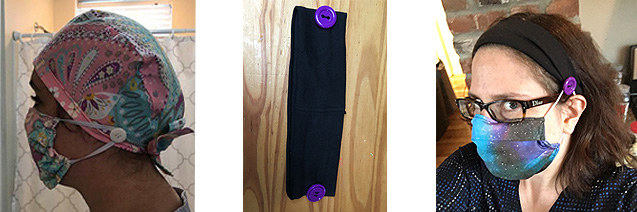
Those who prefer elastic but dislike sore ears sewed buttons onto surgical caps or headbands, or used 3D printed straps. The elastic is wrapped around the button or the 3D printed guard instead of the ear.
#4 – Metal Nose Clip
A metal nose clip shapes the mask to your facial contours and reduces lens fogging. Possible sources of metal include: hair barrettes, disposable foil baking pans, pipe cleaners, paper clips, and plastic coated metal twist ties (such as the kinds used for bread or for vine training). If your mask contains metal, DO NOT MICROWAVE to disinfect. Instead, hand or machine-wash your mask or leave it in direct sunlight.
#5 – Padding
Some CPG staff decided to pad the nose section of the mask with foam, both for improved seal and comfort over the course of a lab shift. Where to find foam around your house? One possible source is shipping wrap from all of those packages you’ve been ordering. If you have any broken headphones lying around (don’t worry, we won’t tell Marie Kondo), they may contain memory foam. Insoles from old sneakers are another potential source of memory foam, but may be too smelly to use.
#6 – Extra Stocking Layer
To further enhance your mask’s seal and boost its effectiveness, a recent Northeastern University study recommends wearing a nylon stocking layer over a cloth mask. The study suggests cutting 8-10 inches off the leg of a Q size stocking.
Disclaimer: the Northeastern study was released prior to peer review. However, it was inspired by previous research which found a layer of hosiery over a homemade mask was effective at filtering fallout particles from the 1979 Three Mile Island nuclear disaster.
Some CPG staff decided the stocking layer was too tight and difficult to breathe through (though perhaps we just have larger-than-average heads). In one case, the intense seal around the mouth led to the wetting of both layers of mask cotton with breath moisture. It is essential that your mask remain dry, since natural fibers can swell when wet, impacting mask performance. In our extremely casual observation, wearing the nylon layer did not seem to prevent glasses fogging, despite the improved seal.
#7 – Surgical Tape
Use surgical or sports tape to seal the top of your mask to your face to reduce fogging. DO NOT USE packing or duct tape which can cause skin abrasions. Surgical and sports tape adhesive is designed to allow transmission of air and moisture through the adhesive system, which minimizes skin irritation.
#8 – Glasses Positioning
Positioning your glasses/lab goggles on top of the mask can also decrease fogging. Adding either 1) a metal nose clip or 2) padding to the bridge of the nose or 3) bias tape to the top of the mask can help to create a perch for your glasses or goggles to rest on. Most CPG employees found wearing glasses or goggles on top of the mask (with or without a perch) to be the most effective method of reducing or eliminating lens fog.
After taking your mask off, clean your glasses before putting them back on your face since they were just touching the contaminated part of your mask.
Posted by Cambridge Polymer Group on | Comments Off on Cambridge Polymer Group 3D Prints COVID-19 Equipment
Cambridge Polymer Group owns two 3D printers, a PRUSA and a Leapfrog Xeed. We use them for making prototypes and creating custom instrument parts. When Massachusetts Governor Baker issued the shelter-in-place order on March 23rd, we brought our printers home, so that we could join the worldwide movement to alleviate the shortage of personal protective equipment caused by the coronavirus pandemic. The PRUSA called shotgun, so the Leapfrog Xeed had to ride in the backseat.
In the weeks that followed, CPG employees continued to work remotely, and some of us returned to the lab to work on COVID-19 related projects. During down time, our CPG 3D printer operators set to work producing PPE, including CPAP brackets, face shields and ear guards.
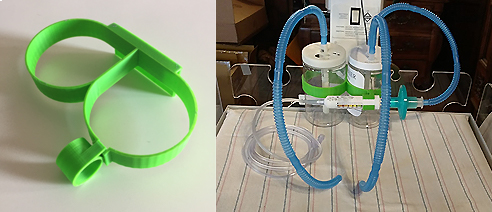
CPAP Brackets For Italian Infants
Cambridge Polymer printed brackets for CPAP units shipped to Italy in anticipation of infants suffering from COVID-19.
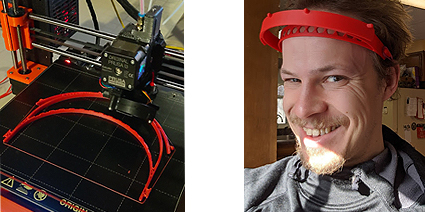
Face Shields For Medical Professionals
CPG also printed face shields for Massachusetts healthcare workers.
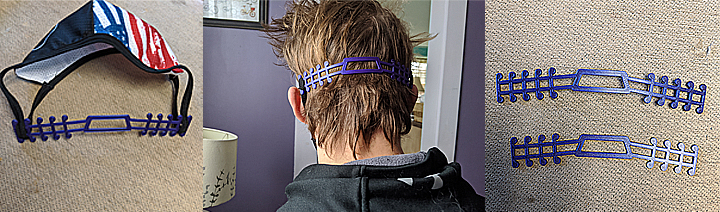
Plastic Straps For Ear Relief
While working in the lab on COVID-19 related projects, CPG scientists discovered firsthand that elastic mask loops cause ear friction. Our CPG 3D printer operators came to the rescue with ear savers. Invented by a 12-year-old Canadian Scout, the 3D printed guard pulls the elastic away from the ears, preventing the elastic from rubbing the ears raw and improving mask fit.
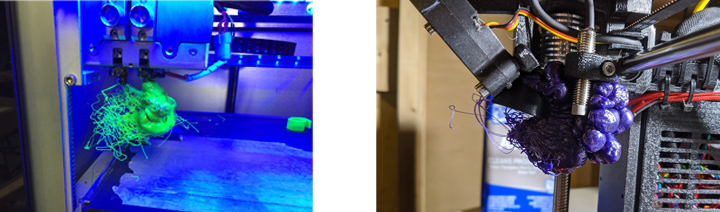
Face Shield Fails For Comic Relief
“Virtually nothing comes out right the first time. Failures, repeated failures, are finger posts on the road to achievement. One fails forward toward success.” – Charles F. Kettering
Posted by Cambridge Polymer Group on | Comments Off on Cambridge Polymer Group Donates Personal Protective Equipment
Concerned about the dire shortage of personal protective equipment in Massachusetts hospitals, Cambridge Polymer staff searched our lab supplies for possible contributions. CPG donated disposable lab coats, shoe covers, hair nets, isolation gowns, surgical masks, nitrile gloves, face shields, goggles and safety glasses through the Massachusetts Emergency Management Agency.
The PPE-gathering staff member who received CPG’s donation was so grateful that initially he wanted to shake hands. We settled for a socially-distant wave.
Posted by Cambridge Polymer Group on | Comments Off on Seismic Shifts in ISO 10993-18:2020
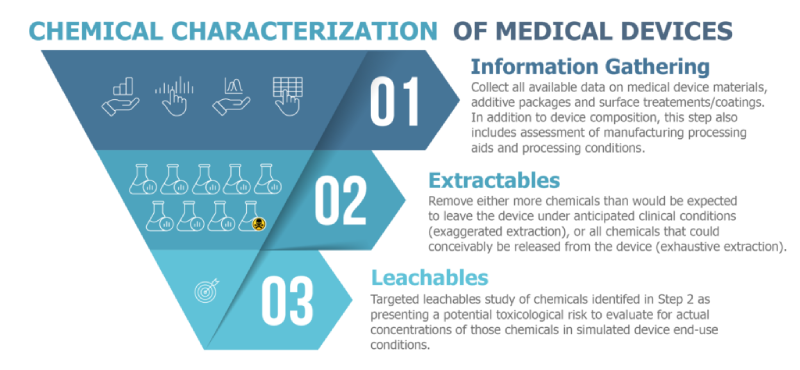
Released this January, the new revision of ISO 10993-18 dramatically expands the scope of determining biocompatibility of medical devices by an additional 49 pages over the previous revision. The standard’s new title “Chemical Characterization of Medical Device Materials within a Risk Management Process” emphasizes the importance this revision places on risk assessment. The chemical risk assessment workflow may be viewed as a three-tiered structure composed of: 1) information gathering 2) extractables analysis, and 3) leachables analysis. The need to perform each successive tier of characterization depends on the nature of the device and the results of the previous stage.
Chemical Risk Assessment Workflow
Made explicit in ISO 10993-18:2020, the critical first step of the chemical risk assessment is information gathering. This involves collecting all available data on the medical device’s materials of construction, additive packages, surface treatments/coatings, etc. In addition to information on the compositional level, the information gathering step also includes collection of the manufacturing processing aids and processing conditions: e.g. machine oils, spin finishes, polishing compounds, sterilization modes, etc.
For devices of greater risk or more uncertainty in materials/manufacturing, an extractables study is likely to be required, at minimum. If an extractables study finds chemicals presenting a potential toxicological risk, a targeted leachable study may be necessary to evaluate the actual concentration of the compound when the device is subjected to simulated end-use conditions.
Other Major ISO 10993-18 Changes
ISO 10993-18:2020 formalizes the analytical evaluation threshold (AET) as a key concept in the chemical characterization of medical devices, guiding the required sensitivity of analytical methods and which compounds must be identified and assessed for toxicological risk.
Previous standards have indicated exhaustive extraction criteria are demonstrated by gravimetric means, however, ISO 10993-18:2020 offers the flexibility of demonstrating this by other more sensitive and relevant means.
As compared to previous standards, ISO 10993-18:2020 provides additional guidance on the selection, qualification, and implementation of analytical methods.
A major change in ISO 10993-18:2020 is the explicit requirement to address analytical method uncertainty. This stems from an inherent constraint of “broad screen” methods that aim to identify a multitude of possible chemical species on a medical device. This uncertainty must be addressed in both defining the AET as well as in performing semi-quantitation.
When Do I Need Chemical Risk Assessment?
Per ISO 10993-1:2018, “chemical characterization (see ISO 10993-18) shall precede any biological testing…chemical characterization with an appropriate toxicological threshold can be used to determine if further testing is needed…chemical risk assessment should be performed as the first step in performing a biocompatibility assessment.”
As part of regulatory submissions such as Investigational Device Exemption (IDE), 510(K) Premarket Notification, or Premarket Approval (PMA)
To evaluate a new material of composition or contact material as being chemically equivalent to an “old” material.
As a guideline for internal Quality Control. Chemical risk assessment process yields a wealth of information that may be leveraged not just for the purposes of a regulatory submission, but for better understanding and control of the device materials and manufacturing.
“But my device is made up of biomedical grade materials. Do I really have to do a chemical risk assessment?”
It is true that the use of USP Class VI, ISO 5832, or FDA Master File Materials can reduce the risk of potentially toxic extractables. However, such designations are usually associated with the raw material, which may be transformed or change in composition during the process of converting it to the final finished form. Therefore, the use of a “biomedical” grade material is generally not sufficient justification to avoid chemical characterization or extractable testing.
How Do I Comply with ISO 10993-18:2020?
Given the dramatic changes and changing regulatory landscape, medical device manufacturers are encouraged to review the standards carefully, consult with expert practitioners, and where possible present a detailed experimental protocol to the FDA ahead of time.
CPG is experienced in designing chemical risk assessment studies and has a full, in-house analytical chemistry laboratory under ISO 9001/17025 quality management systems. We have a successful track record in helping our clients perform chemical characterizations as part of their broader biocompatibility risk assessments. Please contact us for more information on how we can assist in evaluating your devices to these new standards and workflows.
Posted by Cambridge Polymer Group on | Comments Off on Hydrogels: Bandages or Jello?
We have all experienced the challenges of keeping a bandage on a wound when the skin becomes wet from sweat, water, or blood. Traditional bandages rely on adhesion between a portion of the bandage and the skin. This adhesive bond is compromised when water or other fluids penetrate between the layer.
Hydrogels have been examined in the past as a potential alternative to traditional bandages. Hydrogels, which are three dimensional networks of a hydrophilic polymer that is crosslinked to prevent dissolution, can be designed to have adhesive qualities even in the presence of water.
Researchers at Harvard University are experimenting with two naturally occurring hydrogels (alginate, from seaweed, and chitosan, from the shells of crustaceans) to make a hydrogel bandage that looks like a patch. The hydrogels also incorporate a thermo-responsive polymer (NiPAAM) so that the patch shrinks upon skin exposure, bringing the edges of the wounds together. Early studies on mice show that wound closure is significantly faster than traditional bandages or hydrogels lacking the thermo-responsive polymers.
Posted by Cambridge Polymer Group on | Comments Off on Cellulose: Missing the Forests for the Trees
Figure 1: Chinese woodprints of the papermaking process (Wikimedia Commons)
Cellulose is one of the most abundant organic compounds on earth and utilized in applications as diverse as textiles, papermaking, food packaging, filtration, drug delivery systems, wound care products, nanocomposites, bone tissue engineering, and countless others. Cellulose is a fibrilar and semi-crystalline biopolymer which may be plant-derived or bacterial-derived, and generally exhibits remarkable mechanical properties as well as desirable biodegradability, biocompatibility, renewability, chemical stability, and cost effectiveness. [1]
Cellulose is notoriously difficult to process. Up until approximately 300 million years ago, there were no significant microorganisms capable of digesting cellulose—resulting in a high accumulation of organic matter. During this “carboniferous” period, the production of coal derived from biomass was 600 fold higher than estimated rates of production in modern day. [2]
Molecular Weight Analysis of Cellulose
As polymer and material scientists, we rely in fundamental measurements of polymer properties to understand the material performance in demanding circumstances. Typically, this includes measurement of the polymer molecular weight—however, this is a highly challenging measurement to obtain for un-modified cellulose materials. Simply put, cellulose doesn’t dissolve in most solvents as a consequence of its crystalline structure, hydrogen bonding, and hydrophobicity.
CPG has developed workflows for the molecular weight analysis of cellulose materials, including un-modified cellulose. Samples are carefully prepared in a series of matrix-modifying steps before ultimately being dissolved in an aprotic solvent and in the presence of high inorganic salt concentrations. Once in solution, the cellulose materials are analyzed by triple detection GPC for absolute measurement of the polymer molecular weight as well as structural characterization. By obtaining such fundamental measurements of molecular weight and structure, cellulose products may be evaluated for (bio)degradation, aging, failure analysis, material compatibility, lot-to-lot consistency, among other properties. Contact CPG for additional information on the material characterization of cellulose or other biopolymers.
[1] A. Amalraj, S. Gopi, S. Thomas, and J. T. Haponiuk, “Cellulose Nanomaterials in Biomedical, Food, and Nutraceutical Applications: A Review,” Macromolecular Symposia, vol. 380, no. 1, p. 1800115, 2018.
[2] P. Ward and J. Kirschvink, A New History of Life: The Radical New Discoveries about the Origins and Evolution of Life on Earth. Bloomsbury Publishing, 2015.
Posted by Cambridge Polymer Group on | Comments Off on Extractables of Metallic Devices
Do I have to do chemical characterization?
Is it appropriate to perform extractables testing and chemical risk assessment on metallic components?
As such evaluations are most commonly associated with polymeric constructs, it may seem strange to evaluate a solid metallic component in this way.
ISO & FDA Medical Device Guidance
For clarity on this issue, we turn to ISO 10993-1:2018 and the FDA 2016 guidance on biocompatibility assessment. These documents emphasize that the first step in assessing a device’s biocompatibility is in compiling a detailed understanding of the physical/chemical properties and chemical composition of the device. Only once this information is in hand can an evaluation and risk assessment be performed with regard to toxicological endpoints such as carcinogenicity, genotoxicity, etc.
Base Alloy vs. Surface Residue
For a metallic device, the question of chemical composition may seem straightforward: is it simply the alloy the device is machined or otherwise manufactured from? Unfortunately, considering only the base alloy does not take into account the processing aids which are used in the manufacture of the device and which may be left behind as residues on the surface of the part. These may include polishing compounds, lubricants, machine oils, cleaning agents, or adhesive residue from tape used to ‘mask off’ regions of the device. Inorganic residues (particulates, ions, elemental impurities, etc) that may be released should also be considered separately from the base material. An additional factor to consider is if the component has highly porous regions (e.g. to facilitate osseointegration) which may make the device more difficult to clean and in which manufacturing residues may linger.
Chemical Risk Assessment or Cleanline Validation?
In some regards, extractables and chemical risk assessment on metallic components blurs the line with the scope of work performed as part of a cleanliness assessment or clean-line validation – the workflows are in many ways similar and involve extracting the device in solvents of varied polarity and analysis of resultant extracts using techniques such as GC-MS, LC-MS, and ICP-MS. The results of this testing are a list of the identified organic and inorganic extractables which may then be inputs into a toxicological risk assessment. Often this process–other than being a key starting point of the ISO 10993-1 biocompatibility assessment– may mitigate the need for more extensive (and expensive!) animal testing.
Posted by Cambridge Polymer Group on | Comments Off on Extractables of a Short-Term Implant
Do I have to do chemical characterization?
Overheard at a recent conference: “Oh, our device isn’t a permanent implant, so we don’t need to do extractables testing.”
Is that right? If a device is implanted for less than 30 days (or even less than 24 hours), is extractables and chemical characterization unnecessary?
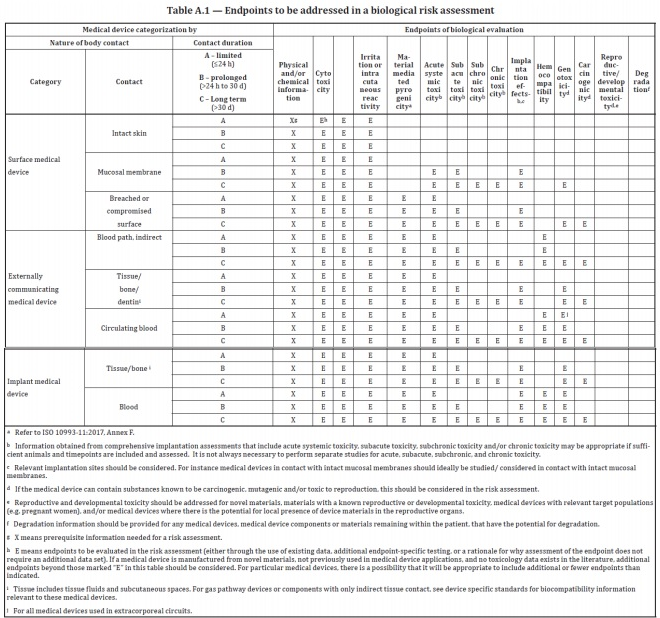
For clarity on this issue, we turn to ISO 10993-1:2018 and the FDA 2016 guidance on biocompatibility assessment. Each of these references contains a table which breaks down the biocompatibility evaluation endpoints associated with different implantation durations and the nature of body contact. Even in the case of a “limited” contact duration of less than 24 hours, these documents indicate that a biocompatibility assessment be performed. What does that entail, however?
The first step in performing any extent of biocompatibility assessment is to compile a detailed understanding of the physical/chemical properties and chemical composition of the device. Only once this information is in hand can an evaluation and risk assessment be performed with regard to toxicological endpoints such as carcinogenicity, genotoxicity, etc. For short term implants, the number of biocompatibility evaluation endpoints is generally less extensive than long term implants.
If the chemical composition of the device (both the raw materials as well as any manufacturing residues) are unknown or have not been previously characterized, an extractables assessment is typically necessary to determine the composition. Unless the device manufacturer has previous experience characterizing the material/manufacturing process by extractables, sufficient information on the device composition (including impurities, manufacturing residues, etc) is generally not available for this to be a pure paper exercise.
Note that from an analytical perspective, given the short term nature of the device, the analytical evaluation threshold (AET) employed will be less stringent than for a permanent implant. This means that when evaluating extractables data from techniques like GC-MS, and LC-MS, the number of peaks which must be identified and submitted for toxicological risk assessment is significantly lower than for a permanent implant–translating to generally lower cost and faster turnarounds.