Posted by Cambridge Polymer Group on | Comments Off on Annual Meeting of the Orthopedic Research Society
CPG will have an exhibit at the upcoming annual meeting of the Orthopedic Research Society in San Francisco, CA, from February 4th to February 7th. This conference brings researchers, medical device manufacturers, surgeons, and regulatory agency representatives together to discuss the latest technologies, practices, and clinical outcomes in the area of orthopedic surgery, including hip, knee, spine, shoulder, ankle, and other joint spaces. Come visit us to learn about the latest work we are doing in this growing area.
Posted by Cambridge Polymer Group on | Comments Off on Synthetic Tissue Models
Cambridge Polymer Group is now partnered with Pulse Anatomy to produce custom anatomy models made from our patented materials for use in clinical device development and professional education. Pulse replicates the anatomy using digital data as a starting point for the process of printing of rapid prototyped parts, creating molds and producing castings. Pulse’s team includes digital designers, mechanical and electrical engineers, artists, sculptors, model makers and machinists. The process of developing a model with the Pulse and Cambridge Polymer Group team is a collaborative effort with our clients to ensure the final product meets the clients criteria. Please visit Pulse Anatomy for more information on model choices, or contact CPG.
Our tissue models can be fabricated from silicone, polyurethane, or tissue-mimicking hydrogels using our patented formulations.
Posted by Cambridge Polymer Group on | Comments Off on Increased Data Collection in Medical Devices
The U.S. Senate has introduced a bill that allows the FDA to require medical device companies to collect and track data on the clinical performance of their marketed devices, such as hip and knee replacements. This action is in part due to the on-going reported issues of metal-on-metal hip implants failing due to metal ion sensitivity, which some studies have shown lead to the formation of pseudo-tumors. Advocates for this data collection suggest that the information will be useful for the on-going 510(k) regulatory approval process for new devices that have similar characteristics to already marketed devices, for-going the need for clinical studies necessary in a full PMA process.
Posted by Cambridge Polymer Group on | Comments Off on Product Differentiation
When marketing a new product, differentiating your product from your competition can be a nuanced activity, depending on the nature of the product. In more tightly regulated markets, customers may require side-by-side comparisons of their existing approved and validated products with your new offering, to ensure that it has the same or better properties. As they have usually gone through some time and expense to validate the product, be it a raw material or finished good, and they bear a risk in changing, you need to demonstrate that the risk is worth it in terms of cost-savings or improved performance.
At Cambridge Polymer Group, we often assemble and perform a set of standard or customized tests that helps the client highlight the key performance traits of their product, while also demonstrating that the root level performance characteristics meet or exceed what their customer is currently using. Whenever possible, we use ASTM standard tests in the relevant industries to assemble a single page of testing results that your sales group can provide to customers. We perform these tests in our ISO-certified laboratory, so you can be assured of the quality and un-biased nature of our results.
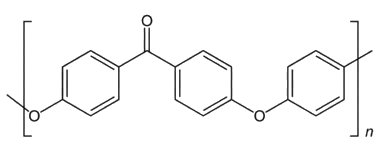
Posted by Cambridge Polymer Group on | Comments Off on Analysis of Poly(Ether Ether) Ketone (Peek)
PEEK finds itself increasingly being used in medical device applications due to its strength, biocompatibility, resistance to radiation and degradation, and ease of processing. CPG has been providing testing services on PEEK for our clients for several years, including crystallinity assessment by DSC and FTIR, mechanical properties, surface morphology characterization, and rheological characterization. CPG now offers gel permeation chromatography assessment of molecular weight distribution of PEEK.
Posted by Cambridge Polymer Group on | Comments Off on New Testing Capabilities at Cambridge Polymer Group
Cambridge Polymer Group now offers the following testing capabilities:
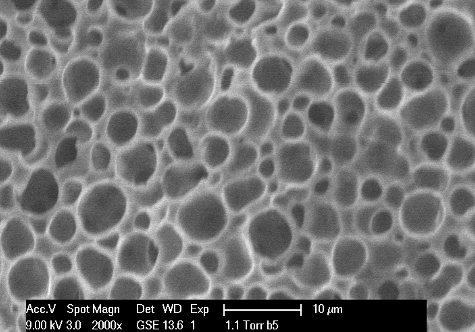
Variable Pressure/Environmental Scanning Electron Microscopy
Conventional scanning electron microscopy requires high vacuum and samples with a conductive surface. Polymeric materials usually have to be coated with a metal layer (gold, palladium, iridium, carbon), and wet samples must be thoroughly dried. With variable pressure SEM, wet and uncoated samples can be imaged. Cambridge Polymer Group has used this technique to examine the microstructure of hydrogels, as well as salts.
Confocal Raman Spectroscopy
A complementary technique to infrared spectroscopy, Raman spectroscopy can be conducted on wet samples without the interference of water. Raman maps can be constructed, providing compositional information as a function of position on the sample.
Posted by Cambridge Polymer Group on | Comments Off on Magneto Rheometer
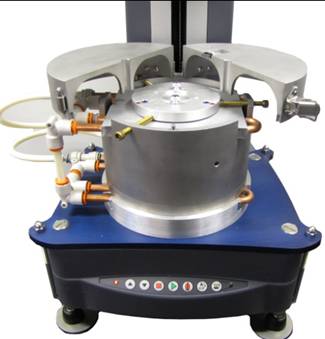
Engineers are increasingly turning to so-called smart fluids to solve complex mechanical problems. One specific type of smart fluid is the magnetorheological fluid (MR fluid) which greatly increases its viscosity to the point of becoming a viscoelastic solid when subjected to a magnetic field. Importantly, the yield stress and viscosity of the fluid when in its active state can be controlled very accurately by varying the magnetic field intensity. CPG has recently developed an MR fluid testing apparatus that integrates with a standard shear rheometer made by TA Instruments.
The MR fixture mounted on a TA Instruments AR-G2 shear rheometer
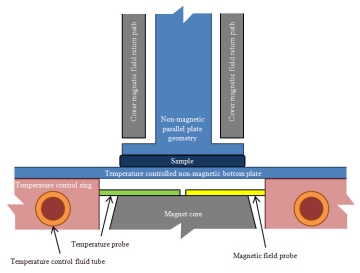
CPG has developed a hardware and software add-on that enables a current commercial shear rheometer to test magnetorheological fluids across temperature and field strengths relevant for a wide range of industries. The MR fixture leverages existing rheometer hardware and uses a parallel plate geometry in a controlled magnetic field over a wide temperature range while monitoring conventional shear viscosity parameters such as stress, strain and viscosity in steady or dynamic shearing modes. The high power magnet of this instrument provides the ability to characterize magnetorheological fluids through the spectrum of magnetic flux ranging from -1 to +1 Tesla, or more and across a broad temperature range.
The MR fixture is sold through TA Instruments. Contact Cambridge Polymer Group for more details.
Schematic diagram of sample shearing zone of MR fixture
Posted by Cambridge Polymer Group on | Comments Off on Hydrogel Tissue Models
Hydrogel Uterus Model
Cambridge Polymer Group designs and fabricates hydrogel-based tissue models. These models can be used for medical practioner training, imaging phantoms, and medical device testing. Using our patented hydrogel technology, we can cast hydrogels into a variety of shapes, including systems with inclusions, additives, and spatial gradients. Our models have found extensive use in the cardiovascular arena, as well as women’s health products.
Posted by Cambridge Polymer Group on | Comments Off on FDA Revisions to the 510(K) Process
The FDA has just issued a new draft document detailing if medical device manufacturers who have a product previously cleared by the 510(k) process, and have made changes to that product, have to refile another 510(k) for that product. The two main questions that a device manufacturer must ask about their revised device are as follows:
Have the changes significantly affected the safety or efficacy of the device?
Has there been a major change or modification in the intended use of the device?
If the answer is yes to either of these questions, then a resubmittal of the 510(k) application may be necessary. The predicate for the resubmittal should be the cleared and marketed device on which the modifications have been made, as opposed to a competitor device or another device marketed by the manufacturer. Changes are not limited to material or design, but also to manufacturing process changes that meet one of the above two questions. Packaging, labeling, and sterilization modality are included in these criterion.
Posted by Cambridge Polymer Group on | Comments Off on Psychorheology
Psychorheology is a term that is familar to the food industry, having been used for many years. Its use in other areas, such as consumer products, is slowly starting to make its way into the common lexicon. Psychorheology is the relationship between instrumental data and sensory data. Sensory data may include ‘mouth-feel’, warmness, and richness. Consumer products companies often conduct panel studies on their developmental products. An assembled panel of consumers will test different formulations of hand creams, and then will fill out forms ranking the creams in terms of smoothness, thickness, slimyness, stringiness, warmth, and a variety of other sensory perceptions. While these rankings are very important to marketing and development people, it would be beneficial to R&D staff to be able to assign these characteristics to new formulations without the time and cost of assembling the panels. By assembling a database of quantitative, instrument-based numbers that are associated with the panels’ more qualitative perceptions, the researcher can a priori tell how their new formulation will be perceived.
One single test is usually insufficient for this type of analysis. Rheology, or the study of fluid motion, is most commonly employed, as it provides information on viscosity, elasticity, and other properties that scale with sensory perception. However, other tests are employed. For example, smoothness or slimyness is usually associated with coefficient of friction, with slimyness also associated with the rheological properties of the material. Stickiness is a property associated with both tack and extensional flow properties, whereas stringiness is more associated with extensional flow properties alone. The gel-like behavior associated with high quality shampoos is related to the yield stress properties of the material; the material will retain its form under gravitational conditions, but will flow when sheared between the hand and scalp.
Cambridge Polymer Group assists clients with designing a testing suite to characterize the psychorheological characteristics of their materials, with the intent of finding testing conditions that distinctly separate formulations that have shown a sensory separation in field testing. With these suites, we then characterize the client’s formulations, forming a database of properties, from which R&D staff from many divisions within the company can select components to achieve a specific sensory experience.