Posted by Cambridge Polymer Group on | Comments Off on Updates From May 2013 ASTM Meeting
The Spring ASTM meeting of F04 (Biomedical Materials and Devices) met in Indianapolis, IN this week. Some key highlights of the meeting are as follows:
Cleanliness of Biomedical Devices
The standard for shipping of potentially infectious tissues and devices was approved, and is now available as ASTM F2995-13.
ASTM F561 (Device retrieval) will be amended to contain a new method for isolating polyethylene particles from tissue.
Two draft standards were discussed. The first, Validating Cleanlines for Biomedical Devices and Instruments, is making good progress, and should be ready for another sub-committee vote prior to the next meeting. The second, Test Soils, is awaiting more information on formulas from some committee members. Two additional draft standards (Designing devices for cleaning, and Establishing threshold limits for residue levels) are expected to be ready for discussion by the November meeting.
Polymers
The committee on UHMWPE discussed several topics, including the need for 3 new standards:
Electron spin resonance spectroscopy of free radical content in UHMWPE.
Fatigue crack propagation analysis of UHMWPE
Oxidation induction time quantification of antioxidant concentration in UHMWPE
Cambridge Polymer Group is working on these three draft standards.
Additional discussion included a small punch round robin study on UHMWPE, which is expected to take place in the next few months. The PEEK standard was also discussed, with debate on the need for different classifications of PEEK, along with additional test methods for extractables and metals levels in PEEK.
A workshop on polymer additives is being considered for a meeting 1 year from now. Interested parties should contact Cambridge Polymer Group for more details.
Bone Cement
CPG researchers suggested a modification to the existing benzoyl peroxide titration method in F451. A small round robin will take place in the next 6 months trying this new protocol.
Posted by Cambridge Polymer Group on | Comments Off on Metal on Metal Hip Implants
J&J Depuy, maker of the Ultamet Metal-on-Metal acetabular hip system, has announced that they will no longer market this and related metal-on-metal products after August 31st. Since around 2007, the use of metal-on-metal has been in steady decline due to concerns about metal ion release and its possible association with pseuodo tumour formation in some patients. The main advantage of metal-on-metal components is the ability to use a thin liner, which allows the surgeon to use the largest possible femoral head without the removal of an extensive amount of bone from the acetabulum. A larger head normally will result in less subluxation and dislocation in patients prone to these phenomena. The lack of compliance in metal bearings, however, results higher wear rates and metal release if there is misalignment in the bearing. UHMWPE, the other bearing material of choice, has greater compliance, and thus can realign in vivo if there is misalignment.
Posted by Cambridge Polymer Group on | Comments Off on MIT Polymer Day
MIT held its annual MIT Polymer Day in March. Cambridge Polymer Group was a sponsor, and also supplied two judges for the poster contest, where students and post-doctoral research fellows presented their work on polymer technology.
Posted by Cambridge Polymer Group on | Comments Off on Crystallinity in Peek
Polyether ether ketone (PEEK) is finding its way into more and more medical devices, due to its high strength, resistance to oxidation, bioinertness, and ease of manufacturing. PEEK is a semi-crystalline thermoplastic, and the crystallinity is strongly dependant on the processing conditions used to form a PEEK component, such as molding and cooling temperatures, sample size, shear rate, and post-molding conditions, such as tool speed and cold working. In a paper presented at the International PEEK meeting in Philadelphia in April, 2013, CPG researchers, along with collaborators from Brigham and Woman’s Hospital and Stryker Orthopedics, discuss different techniques to measure crystallinity in PEEK, including density, DSC, X-ray, and infrared spectroscopy. Work was performed on 4 different PEEK formulations with differing molecular weights.
Posted by Cambridge Polymer Group on | Comments Off on Polymers and Plastics in Medical Devices
Cambridge Polymer Group researcher Gavin Braithwaite will be presenting his work on hydrogels used in medical devices at the upcoming Polymers and Plastics in Medical Devices conference held in San Francisco, CA from June 26-28th, 2013. Dr. Braithwaite’s work discusses injectable hydrogels for nucleus pulposus and tissue augmentation, as well as cartilage replacement technologies.
Posted by Cambridge Polymer Group on | Comments Off on HFIP Quantification
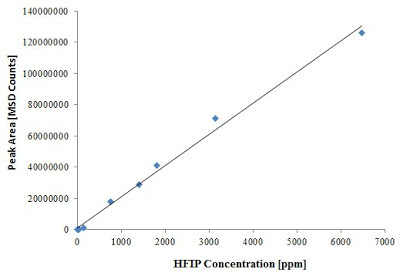
Hexafluoroisopropanol (HFIP), also known as hexafluoro-2-propanol, is a fluorinated alcohol commonly used in processing of polyethylene terephthalate, polyacrylonitriles, some polyketones, and polyamides. It is a fairly toxic material, causing several eye damage and respiratory problems. Consequently, manufacturers who use HFIP need to measure how much residual HFIP remains in their processed goods, particularly if the goods are being used for biomedical purposes.
HFIP can be quantified with solvent extraction followed by gas chromatography-mass spectroscopy. This method can be used to detect HFIP concentrations down to approximately 100 ppb. The technique requires a reliable extraction methodology, and a GC-MS protocol that will provide separation of HFIP from any other co-eluting species that may be extracted from the test sample.
Posted by Cambridge Polymer Group on | Comments Off on A Peek at Peek
On September 25-26, 2013, an international symposium on polyetherether ketone (PEEK) will be held at Drexel University. PEEK is finding increasing use in the biomedical community, particularly in the area of permanent implants. Spinal implants have been composed of PEEK for several years, finding use as stabilization rods, spacers, and articulating surfaces.
Characterization of PEEK has received increasing attention as a consequence. This material has unusual crystallization behavior, and the method of analysis can lead to different results. In a paper written by researchers from Cambridge Polymer Group, Brigham and Women’s Hospital, and Stryker “Macromolecular and Morphological Characterization of Medical Grade PEEK”, we describe 4 methods to measure crystallinity in PEEK (X-ray, DSC, density, and FTIR), and compare the results of multiple grades of PEEK.
Posted by Cambridge Polymer Group on | Comments Off on Fatigue Crack Propagation
Fatigue crack propagation (FCP) analysis is a method to monitor the resistance of a material to crack inception and propagation under cyclical loading. ASTM E647 describes the methodology for measuring crack propagation in materials. An example of the typical data obtained in FCP analysis is shown above for GUR 1020 UHMWPE subjected to ionizing radiation measured at Cambridge Polymer Group. There are two principle regimes in a crack propagation plot: (1) crack inception, where the minimum load range required to start a crack to grow is determined; (2) Paris regime, where steady crack growth occurs. The x-axis shows DK, which is derived from linear elastic mechanics and is dependent on the cyclical load range (Pmax-Pmin) and the crack length (a). The expression for DK will depend on the shape of the test specimen, which is often a compact tensile geometry. The y-axis shows the crack growth as a function of number of fatigue cycles. The main reportable items for FCP analysis are the DKincep, or the load conditions for crack growth to reach 1e-6 mm/cycle, and the slope and intercept of the curve in the Paris regime (m and C, respectively). With highly crosslinked UHMWPE, the DKincep tends to decrease, and the material sometimes shows a higher sensitivity to DK in the Paris regime.
Contact Cambridge Polymer Group for more information on E647 testing.
Posted by Cambridge Polymer Group on | Comments Off on Consolidation Defects in UHMWPE
Ultra high molecular weight polyethylene (UHMWPE) is the most commonly used bearing surface in hip and knee arthroplasties. Due to its high molecular weight, UHMWPE cannot be injection molded or extruded with a screw extruder. Compression molding or ram extrusion are the two consolidation processes used for UHMWPE, whereby the combination of temperature and pressure sinter the flakes of UHMWPE together. These processes do not result in co-mingling of the UHMWPE powder, however, so that the original flakes can be readily seen in a cryo-fractured surface (see above). Regulators are interested in verify that consolidation defects, or voids, do not exist in the consolidated UHMWPE. These defects can result in crack formation and failure of the device if the defects are in sufficient quantity and size. SEM analysis of cryo-fractured surfaces is a commonly used technique to look for consolidation defects, along with optical microscopy of microtomed films of the material. Regulatory submissions usually require these analyses, comparing a new formulation of UHMWPE with a cleared and marketed formulation.
Posted by Cambridge Polymer Group on | Comments Off on Analysis of Vitamin E Residues
The increasing prevalence of Vitamin E, a naturally-occuring antioxidant, in medical grade plastics has resulted in a need for analysis methods that can track the effect of processing on this compound. Vitamin E is effective as an antioxidant due to the hydroxyl group sitting on the aromatic ring at one end of the molecule. This hydroxyl group can readily lose a hydrogen and capture a free radical, a culprit in oxidation reactions. The free radical is thereafter stabilized by the Vitamin E molecule.
When processing medical grade plastics, the plastics are exposed to high heats and pressures during molding. Additionally, cleaning agents and ionizing radiation are often used to clean and sterilize the finished components. All these steps can potentially modify some of the Vitamin E molecules.
As a result, medical device manufacturers are usually required to identify and quantify these modified molecules to ensure both that they are safe for in vivo use, and that the material remains adequately oxidatively stabilized. Researchers at Cambridge Polymer Group have developed a series of assays to analyze potential transformation products of Vitamin E, using a combination of chromatography and spectroscopy. Additionally, we have a series of analyses to test the oxidation resistance of stabilized plastics. All these methods have been successfully used for regulatory submissions.