Posted by Cambridge Polymer Group on | Comments Off on Fingerprint Analysis via SEM
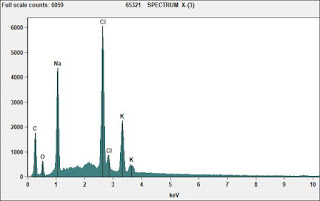
Analysis of fracture surfaces of samples is sometimes complicated by inadvertent contamination the the sample surfaces during sample preparation. Dust and other debris from the lab bench, in addition to particles generated from cutting instruments, can contaminate an otherwise clean surface. If gloves are not worn during sample preparation, finger oils and salts can be left behind. As an example, a prepared polymer surface was freshly prepared by cryofracturing the sample, so that no tooling was used. The sample was then briefly touched with a bare fingertip. The sample, when imaged under SEM, shows the crystalline structure outlined in the white rectangle shown above. The elemental composition of this crystalline material is shown below, and contains salt, chlorine, and potassium. The carbon and oxygen may be from the polymer background, and/or from finger oils transmitted with the fingerprint.
Posted by Cambridge Polymer Group on | Comments Off on Accelerated Aging
Accelerated aging protocols are key to medical device development. For initial product design, manufacturers of medical devices would like to know how their devices will respond to an in vivo environment, for a time period that could extend to decades in the case of permanent implants. For product labeling and regulatory, the manufacturer needs to be able confidently report an acceptable shelf-life for their devices before implantation or use. Shelf-life timeframes are often 2 years, and sometimes as long as 5 or more years. Clearly, this extent of time is too long for a real time aging study at room temperature.
As a result, manufacturers turn to accelerated aging protocols. For shelf-storage, there are a few ASTM methods that are used by device manufacturers. The most popular technique is described in ASTM F1980, which uses increased temperature to accelerate the kinetics of degradation of the materials. In this method, samples are usually placed in a convection oven for a period of time in their final packaging. A relatively simple expression is used to compute the accelerated aging factor, AAF
AAF=Q10^[(Ta – Trt)/10]
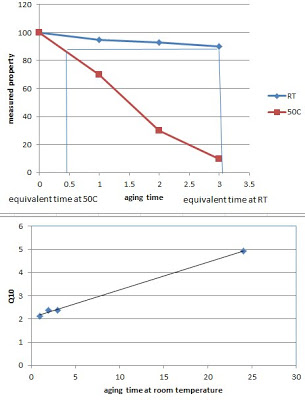
where Ta is the accelerated aging temperature, Trt is room temperature, and Q10 is an aging pre-factor that depends on the material. Ideally, the Q10 parameter is determined by comparing real time testing to accelerated aging testing, picking a parameter (such as tensile strength) to monitor. By measuring this parameter at multiple times during the aging study, one can construct a relationship between this property and aging time. Determining the equivalent amount of time to reach the same change in property at the different aging temperatures allows you to calculate your AAF. Know AAF and Ta, you can now calculate Q10 for your material. The Q10 will sometimes depend on temperature, as shown in the bottom graph. This plot was generated using the variable Q10 method, whereby short term real-time aging data was extrapolated to long term values as indicated.
Posted by Cambridge Polymer Group on | Comments Off on Implants in the After Life
Ever wonder what happens to metal hip and knee replacements after their recipient expires? How about metal pins and screws to hold bones together? In the past, these components, often composed of expensive metals such as cobalt chrome, tantalum, and titanium, were buried with the patient. Now, a Dutch Company, OrthoMetals, has teamed up with crematoriums to recover the metal components from the ash. The recovered components are not for re-use as medical devices, but rather are melted down and used in non-medical applications, such as cars, wind turbines, and general construction materials. The company, which was started in 1997, now recycles up to 250 tons of metal a year.
Posted by Cambridge Polymer Group on | Comments Off on Crush Strength of Catalyst Material
Catalyst powder for chemical reactions is often formed into a packed bed and placed into a reactor vessel. In packing the catalyst, the formation of smaller particles, or fines, can occur if the packing pressure exceeds a critical value. This fine formation is undesirable, as it increases the potential for bed compaction and subsequent increase in pressure in the reactor.
In ASTM D7084, “Determination of bulk crush strength of catalysts and catalyst carriers,” the crush pressure required to generate 1 wt.% of fines is determined, where ‘fines’ are defined as particles passing through a mesh size that is half the diameter of the catalyst pellet. Multiple compression loads are used, and the results are interpolated to determine the pressure that yields 1 wt.%.
Cambridge Polymer Group performs ASTM D7084. Please contact us for more information.
Posted by Cambridge Polymer Group on | Comments Off on Tissue Block for Suture Practice
Traditionally, medical students have practiced suturing on tissue mimics made from silicone or polyurethane elastomers. These materials lack the lubriscious nature of natural tissue. Using our proprietary hydrogel technology, CPG has developed single and multi-layer tissue blocks that contain a similar amount of water as natural tissue, and hence provides a similar feel as natural tissue. These blocks can be formed into a variety of sizes, and are re-usable. Contact Cambridge Polymer Group for more information.
Posted by Cambridge Polymer Group on | Comments Off on FDA Clears Ecima
The FDA has cleared ECiMA(tm), a highly crosslinked polyethylene containing Vitamin E, for use in hip arthroplasties. ECiMA is sold by Corin, and was developed by researchers at Cambridge Polymer Group and the Massachusetts General Hospital. ECiMA was developed as a second generation highly crosslinked UHMWPE to replicate the good wear properties of the first generation highly crosslinked UHMWPEs, while having improved mechanical properties and oxidation resistance.
Posted by Cambridge Polymer Group on | Comments Off on Hip Implant Recall
Johnson & Johnson has continued to investigate their metal-on-metal implants, which were recalled in 2010 due to some patients reactions to metal debris generated during articulation. In a Reuter’s report today, J&J had fourth quarter charges of $800 million associated with medical costs related to the recall.
Posted by Cambridge Polymer Group on | Comments Off on Radiopacity in Medical Devices
Temporary or permanent implants often contain a radiopacifier, which is a material with a higher electron density contrast compared to the surrounding material so that it absorbs X-ray energy. In an X-ray, a radiopacifier appears as a bright section, as shown in the catheter above (the internal wire is a radiopacifier). Radiopacifiers are often made of metals such as gold, tungston, or powders such as zirconium oxide, barium sulphate and bismuth. When considering the design of a new medical device, manufacturers will need to assess the radiocontrast of the device so that the medical practitioner can see the device during implantation, in the case of catheters, guidewires, and other temporary devices with the use of fluoroscopes, or after permanent implantation, in the case of hip and knee replacements, stents, heart valves, and other permanent devices.
ASTM F640 “Standard Test Methods for Determining the Radiopacity for Medical Use” describes test methods for quantitative assessment of the contrast a radiopacifier has in a medical device, for either permanent implantation or temporary. In this method, the device is placed into an X-ray imaging system and imaged using standard times, voltages, and currents used for the X-ray diagnosis of humans. For two of the test methods, body mimics can be used, which may be animal, cadaver, or synthetic components that replicate the portion of the body where the device is to be placed. From the X-ray image of the device, a densitometry system is used to measure the optical density difference between the sample radiopacifier and the background.
CPG performs ASTM F640 using our custom densitometry system. Please contact us for your testing needs.
Posted by Cambridge Polymer Group on | Comments Off on Hydrogel Skin Model
Synthetic tissue constructs have been around since the 1970’s, when Dr.’s Yannas and Burke created an artificial skin from collagen and silicone rubber. This membrane, termed Silastic, was designed to mimic the properties of skin, to help generate new skin in burn victims.
Researchers from the Medical School Hannover (Germany) are trying to replicate human skin through the use of harvested spider silk. L’Oreal and Mattek have design synthetic skin models (EpiDerm from Mattek and EpiSkin and SkinEthic RHE) based on human skin cells.
CPG scientists have developed a multi-layer tissue model to mimic the outer epidermis, fat, muscle, and underlying fascia layer in the skin using CPG’s proprietary hydrogel technology. The model is designed to be used for incision and suture training. Contact CPG for more information.
Posted by Cambridge Polymer Group on | Comments Off on Highly Crosslinked UHMWPE Available for License
Cambridge Polymer Group and Massachusetts General Hospital have co-developed novel, highly crosslinked ultra high molecular weight polyethylenes that incorporate vitamin E and are suitable for hip, knee, shoulder and spine arthroplasty applications. These technologies, generically termed CIMA, E-CIMA and Reservoir Vitamin E, are available for license.
E-CIMA
E-CIMA is a formulation containing Vitamin E throughout the material. Following blending and consolidation, the sample is subjected to ionizing radiation, which forms crosslinks in the material. The material is then deformed at a temperature below the melting point to quench residual free radicals. An annealing step returns the sample to its original shape, after which it is ready for machining into an implant. E-CIMA has wear properties similar to remelted, highly crosslinked UHMWPE, yet has the improved mechanical properties approaching virgin UHMWPE. Coupled with this is the oxidative resistance of Vitamin E.
(2/9/2012 update): Corin has announced that they received FDA clearance on E-CIMA (product name eCiMA).
CIMA
CIMA is similar to E-CIMA, but does not incorporate Vitamin E into the UHMWPE matrix. This material provides good wear, good mechanical properties, and improved oxidation stability over annealed highly crosslinked UHMWPE.
Reservoir Vitamin E
The Reservoir Vitamin E is a surface crosslinked UHMWPE that contains Vitamin E in specific locations, allow targeted crosslinking in regions where wear rates must be control, yet high mechanical properties in regions where locking mechanisms are located. This material has excellent applications for re-surfacing or thin liners in orthopedics, and is available for licensing.
Contact Cambridge Polymer Group for information about properties, licensing and regulatory approval.