
CaBER®
The CaBER®, or Capillary Breakup Extensional Rheometer, is a low cost, easy to use instrument for quantifying the flow response of a polymer liquid and melt to an extensional deformation. This instrument can be used to quantify the viscosity, surface tension, relaxation time, and breakup time of filaments formed in an extensional flow. This instrument was developed under an SBIR grant from the NSF.
Since its release in 2002, the CaBER has been the only routine method for measuring the extensional viscosity of moderate viscosity solutions and melts. More recently, a handful of similar instruments have been released, but a “CaBER” test is now ubiquitous with the determination of extensional fluid properties. With over 300 papers explicitly mentioning “capillary breakup extensional rheometer” published, and a field of interest in capillary breakup yielding thousands of papers, there is a clear interest in the technique that has been growing consistently over the years. A complete list of publications using the phrase “capillary breakup extensional rheometer” is provided here.
CaBER® Upgrades
CPG is pleased to announce a range of enhancements that greatly improve the flexibility of the instrument and the quality of the data generated. These enhancements are designed to interface virtually transparently with the existing instruments.
Enhancements
- Enhanced Resolution: New data acquisition system improves theoretical resolution to
- Conductivity Determination of Break-up: By adding a conductivity sensor between the plates a measure of the breakup-time can be obtained in situations where the laser micrometer is not sufficient, such as for very-low viscosity fluids and for unusual deformation modes.
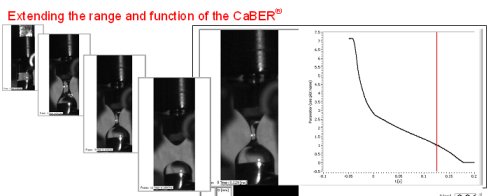
- Synchronized Video Acquisition: A separate software modules runs in parallel with the CaBER® software to allow capture of images synchronized to the CaBER® data.
- Black and White
- Maximum frame rate 100fps (720x280 pixels)
- Minimum shutter time 0.5 ms
- Maximum recommended frames 200
For more information, contact CPG.