


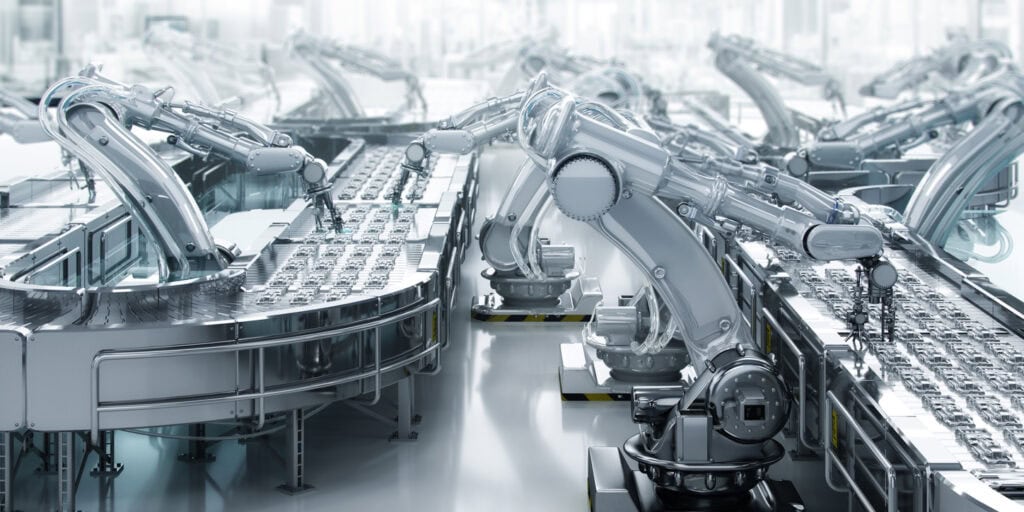
Industrial robotics places demanding and often conflicting requirements on polymers, elastomers, and composites used in structural frames, end-effectors, housings, and motion components. Materials must deliver durability, wear and fatigue resistance, and environmental stability while still meeting aggressive cost and supply chain constraints. Weight reduction without sacrificing mechanical performance helps extend battery life and increase payload, enabling more agile mobile robots and collaborative systems.
Typical Challenges for Industrial Robotics
- Wear, friction, and fatigue in gears, bearings, and sliding interfaces under repetitive motion.
- Chemical and temperature exposure from coolants, lubricants, cleaning agents, or outdoor conditions.
- Dimensional change and creep under sustained loads, degrading precision and positioning over time.
- Evaluating replacement materials when qualified grades become unavailable or obsolete.
Industrial Robotics Materials Services
Cambridge Polymer Group supports industrial robotics programs from early material selection through production troubleshooting and life-cycle testing. Services include:
- Guiding material selection and substitution for polymers, elastomers, and composites used in structural and moving components, with data on mechanical properties, friction and wear, and chemical resistance.
- Developing and characterizing soft solids, seals, gaskets, and coatings to manage friction, damping, sealing, and environmental resistance in joints and housings.
- Designing environmental and accelerated aging studies that replicate field conditions such as temperature cycles, humidity, UV, and exposure to oils, solvents, and cleaners.
- Performing failure analysis and root-cause investigations for cracked, worn, or degraded components, feeding results back into design and process improvements.
- Providing verification and validation testing aligned with internal specifications or customer and industry requirements for mechanical, tribological, and surface performance.
How CPG Helps Industrial Robotics Teams
Cambridge Polymer Group applies expertise in soft solids, environmental aging, material design, and advanced materials testing to the specific demands of industrial robotic equipment. This work spans early feasibility studies for new platforms through to qualification of production materials under realistic duty cycles, temperatures, and chemical exposures.
For factory and logistics applications, support often includes:
- Screening and down‑selecting polymers, elastomers, and composites for gears, bearings, housings, grippers, and cable management in defined operating environments.
- Building test plans that target durability, friction and wear, creep, and stability, so design teams can compare candidate materials on relevant performance metrics rather than datasheet values.
- Translating test data into design guidance, such as allowable stress levels, expected service life, or required safety factors under specific loading and environmental conditions.
When soft components are involved (seals, dampers, pads, or soft‑contact interfaces), CPG helps connect formulation choices and processing conditions to properties like compression set, damping behavior, and long‑term dimensional stability. This integrated approach enables industrial robotics engineers to make confident material selections, support design verification and validation, and reduce the risk of field issues or premature component failures in high‑throughput automation environments.